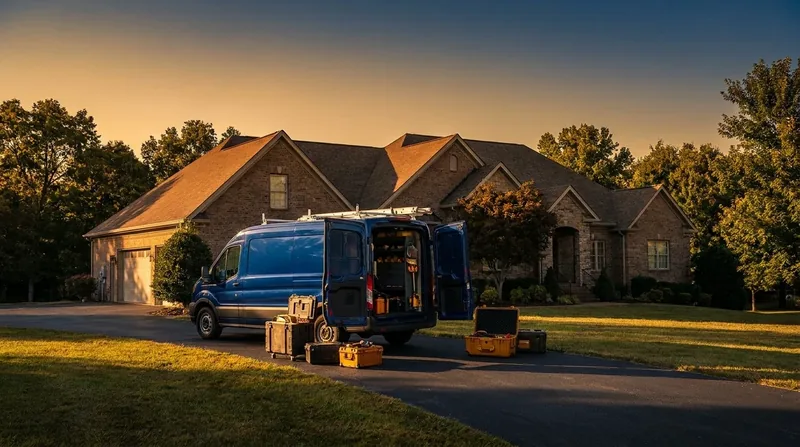
How to Start a Pest Control Business in Georgia: Structural Pest Control Commission License and Exams
How to Start a Pest Control Business in Georgia: Structural Pest Control Commission License and Exams
Structural pest control in Georgia is licensed by the Georgia Department of Agriculture through its Structural Pest Control Division, and the rules come from the Structural Pest Control Commission. A pest control company needs three things from that system: a company license, at least one certified operator who qualifies the business, and technicians who are registered employees. The Secretary of State handles your entity filing separately, and the licenses below are what let you treat or advertise.
This is a different license set from the pesticide contractor license that lawn care and landscape companies use. If your business will spray lawns and landscapes, read our guide to starting a lawn care business in Georgia first, then apply for the license that matches each service you plan to offer. Don't assume one license covers the other.
Informational notice: This article is general information, not legal or tax advice. Fees, deadlines and exam details change, so confirm every figure with the Department of Agriculture before you apply. For entity choice, taxes and contracts, talk to a Georgia attorney or CPA.
What You Need Before You Apply
Gather these items before you start the license process. Missing documents are the most common reason applications stall.
- Verifiable work experience records: Pay stubs, employer letters or other proof of structural pest control work, entered on the Department's experience forms.
- Education records (if you rely on a degree): Transcripts or diplomas for a related degree, which can substitute for part of the experience requirement.
- Secure and Verifiable identity documents: Department licensing requires identity documents that meet its secure and verifiable standard. Check the accepted list before you submit.
- Proof of insurance: Required for the company license. Ask the Department for the current minimum coverage. Do not assume a figure.
- Entity formation documents: Your Articles of Organization or Articles of Incorporation, if you have already filed them with the Secretary of State.
- A payment method for each fee listed in the cost table below.
Step 1: Understand the Three Credentials and Their Order
Georgia pest control licensing has three credentials. Work through them in this order, because the company license depends on the operator, and the technicians depend on the company.
- Certified Operator: the individual who qualifies the company.
- Company license: the business authorization to treat and advertise.
- Registered employee credential: each technician who performs the work.
Step 2: Qualify and Certify as the Certified Operator
The Certified Operator is the key credential. You need either two years of verifiable structural pest control experience, with at least one of those years within the last five years, or a related degree plus one year of experience. Document both on the Department's forms and keep copies.
Next, pass the core exam and an exam in each category you plan to offer. Category exams cost about $45 each. Once you pass, the credential fee is $100. Plan your category choices carefully, since each one adds an exam. The main categories are:
- Household Pest Control (category 29): Ants, roaches, rodents and other general pests in homes and businesses.
- Wood-Destroying Organism: Termite and similar inspection and treatment work. Termite letters and wood-destroying organism reports are regulated activities in this category.
- Fumigation (category 28): Structure fumigation work.
Your Certified Operator credential expires June 30 of odd-numbered years, and renewal costs $100. To recertify every five years, you can complete continuing education units or retake the exam. The required CEUs are 25 for Household Pest Control, 25 for Wood-Destroying Organism and 12 for Fumigation. Since April 1, 2025, the old cap on conference and workshop CEUs has been removed under Commission Policy 13-01, so check the current policy for what counts. Georgia does not offer reciprocity for operators, so an out-of-state license does not transfer automatically.
Common mistake: counting the wrong experience
Experience must be verifiable and documented on the Department's forms. Informal work, unpaid helping or time you cannot prove will not count. Get written confirmation from past employers before you leave a job.
Step 3: Apply for the Company License
The company license application costs $100 plus a $70 research fee for the University of Georgia entomology program, for a total of $170. Include proof of insurance and the Certified Operator's approved credential. Your application must be complete before it goes to the Commission.
The Commission approves new licenses monthly, at its meeting on the second Tuesday of the month. Get your application in by the 1st of the month to be considered at that month's meeting. Missing that date can push your approval to a later meeting, so build the timeline into your launch plan.
When you apply, choose your categories. The company license must be in place before you advertise or perform any treatment. Advertising before approval is one of the fastest ways to draw a Department action.
If you will run a small satellite office with a single employee, ask the Department about a sub-office license. It is a separate application, so don't assume your main license covers it.
Step 4: Register Your Technicians
Every person who performs pest control work for your company needs the registered employee credential. The steps are:
- Complete 10 hours of classroom training.
- Pass the registered employee exam, which costs $45.
- Pay the $10 registration fee.
The credential is valid for two years and ends June 30 of odd-numbered years. Continuing education is 8 hours for Household Pest Control, 8 hours for Wood-Destroying Organism and 3 hours for Fumigation. Track these dates for every technician on a shared calendar, because a lapsed credential can stop a job mid-week.
Common mistake: hiring before registration
Don't put a new hire on a treatment before that person's registration is complete. Schedule training and the exam before the first day in the field, and plan your staffing around the exam date.
Step 5: Form the Business Entity and Register for Taxes
Pest control licensing and business formation are separate processes. Most owners form an LLC or corporation first, then add the Department licenses on top. For an LLC, the Articles of Organization cost $110 total, which is the $100 fee plus a $10 service charge. Corporations file Articles of Incorporation for the same $110. Both can be filed online or on paper through the Georgia Secretary of State eCorp portal. Online filings take about 7 to 10 business days, and paper filings take about 15 business days. Expedited review costs $120 for 2 business days, $275 for same-day service if received by noon, or $1,200 for one hour on business days.
Georgia levies no franchise tax on a typical single-member or partnership LLC. Corporations, and LLCs taxed as corporations, owe a net worth tax of $0 to $5,000 depending on net worth. Income passes through at the flat individual rate, which is 5.19% for 2025 and 4.99% for 2026. The corporate income rate equals the individual rate. For the full LLC process, see our guide on how to start an LLC in Georgia, and for an overview of state taxes, see our Georgia business taxes guide.
Next, register with the Georgia Department of Revenue through the Georgia Tax Center if you will sell taxable goods or have employees. Pest control services are generally not taxed in Georgia, but products you sell to customers may be. Confirm the treatment of your specific sales with the Department of Revenue. Registration itself is free, and Georgia issues no separate resale permit. The resale instrument is Form ST-5, the certificate of exemption.
Step 6: Get the Local Occupation Tax Certificate
Georgia has no general statewide business license. The local license is an occupation tax certificate, often called a business license, issued by your city or, for unincorporated areas, by your county under O.C.G.A. Title 48, chapter 13. Each of Georgia's 159 counties and about 537 cities sets its own formula, deadlines and prerequisites. A business located inside a city pays the city, not the county. More than half of Georgians live outside any city, so for many pest control owners, the county is the issuer.
Private employers with more than 10 employees must file an E-Verify affidavit to get the local certificate, under O.C.G.A. 36-60-6. Ask your local office about its exact prerequisites, and do this before you advertise or open for business. For more detail, read our guide to the Georgia business license.
Step 7: Carry Workers' Compensation Coverage
Workers' compensation is required once you have three or more workers, including part-time employees. Pest control work involves ladders, crawl spaces, chemicals and vehicles, so get coverage in place before your third worker starts. For the rules, see our guide on Georgia workers' compensation insurance requirements.
Step 8: Set Up Vehicles, Equipment and Records
The Department sets rules for vehicles and equipment used in pest control work, including how products are stored and transported. Review the current requirements on the Department of Agriculture website before you buy a vehicle or wrap it with your company name. The Department also enforces pesticide recordkeeping rules for pest control work done for a fee. Set up a records system before your first paid job, and confirm the required retention periods with the Department.
Cost Summary
These are the figures stated in the Department's guidance and the state filing schedules. They change, so confirm each one before you apply.
| Item | Cost | Where to Confirm |
|---|---|---|
| Certified Operator credential | $100 | Georgia Department of Agriculture |
| Category exams (each) | About $45 | Georgia Department of Agriculture |
| Certified Operator renewal | $100 | Georgia Department of Agriculture |
| Company license (application plus research fee) | $170 ($100 plus $70) | Georgia Department of Agriculture |
| Registered employee exam | $45 | Georgia Department of Agriculture |
| Registered employee fee | $10 | Georgia Department of Agriculture |
| LLC Articles of Organization or corporation Articles of Incorporation | $110 | Georgia Secretary of State |
| Annual registration (LLC or corporation) | $60 ($50 plus $10) | Georgia Secretary of State |
Common Mistakes to Avoid
- Advertising or treating before the company license is approved. Wait for approval, then launch your marketing.
- Missing the monthly approval cutoff. Submit by the 1st of the month to be considered at the second Tuesday meeting.
- Assuming an out-of-state license transfers. Georgia does not offer reciprocity for operators.
- Letting credentials lapse. Operator and registered employee credentials both end June 30 of odd-numbered years.
- Treating the lawn care license and the structural license as the same. Each has its own requirements.
- Using the wrong city or county for the local certificate. A business inside a city pays the city.
- Hiring a third worker without workers' compensation. Coverage is required at three or more workers.
Expected Results
Once licensed and operating, a well-run pest control program may help reduce pest activity in a building. Results depend on the type of pest, the structure, the product label, the treatment method and any follow-up service the customer agrees to. Your marketing should describe services and what they are designed to do. Avoid promises of guaranteed elimination, and avoid claims that a product or treatment will fix every problem. Keep your advertising accurate and consistent with the product labels you use.
Next Steps
Start with the Certified Operator. Confirm the experience requirement, gather your records and schedule the exams, because everything else depends on that credential. While you wait, form your entity through the Georgia Secretary of State eCorp portal, and plan your local certificate and insurance. Once your operator is certified and your company license is approved, register your technicians and open for business.
Reminder: This article is informational and is not legal or tax advice. Before you form your business, sign contracts or make tax decisions, consult a qualified Georgia attorney or CPA.
Keep exploring: related Georgia guides
- How to Start a Lawn Care Business in Georgia
- How to Start a Pressure Washing Business in Georgia
- How to Start a Laundromat in Georgia
- How to Start an Auto Detailing Business in Georgia
- How to Start an LLC in Georgia
- Georgia Business License
- Cost to Start a Business in Georgia
- All Georgia business types
- Every Georgia guide in one place