How to Start a Laundromat Business in Georgia
How to Start a Laundromat Business in Georgia
Laundromats are one of the few businesses that hold up in a recession. People keep washing clothes whether the economy is booming or contracting. In Georgia, the model gets more attractive because your two biggest ongoing costs — utilities and real estate — run lower than in coastal markets. But getting there requires serious upfront capital. The equipment alone can run $100,000 to $300,000 before you’ve flipped a single load.
Here’s what you actually need to open a laundromat in Georgia: the permits, the equipment math, and a realistic picture of what this costs.
Licensing and Permits
No State License Required
Georgia doesn’t have a state-level laundromat license. There’s no application to file with a state agency, no inspection from a state laundry board, and no annual license renewal at the state level. Your compliance obligations land almost entirely at the local level.
That’s good news for paperwork. It also means requirements vary by city and county, so what you need in Savannah differs slightly from what you need in Columbus or Marietta.
Occupation Tax Certificate (Business License)
Every city and county in Georgia requires businesses to obtain an Occupation Tax Certificate — this is what most people call a business license, though technically Georgia doesn’t use that term. You apply through your local city or county government, pay a fee (usually based on gross receipts or a flat rate depending on the jurisdiction), and renew annually.
E-Verify and SAVE are mandatory. Georgia law requires all businesses applying for an Occupation Tax Certificate to comply with two federal verification programs:
- E-Verify: You must enroll in the federal E-Verify system and verify the work eligibility of all employees. You’ll need your E-Verify Company ID number when you apply.
- SAVE (Systematic Alien Verification for Entitlements): Your local government uses this to verify the immigration status of license applicants. You’ll sign an affidavit confirming compliance.
This isn’t optional and it’s not a formality. Missing either one will stall your application. Get your EIN from irs.gov/ein first — you need it to enroll in E-Verify, and enrollment is free at e-verify.uscis.gov.
Certificate of Occupancy
Before you open to customers, you need a Certificate of Occupancy (CO) confirming that your space is legally approved for commercial laundry use. If you’re building out a new space or converting an existing one, you’ll pull a building permit first, go through inspections as the work progresses, and receive the CO when everything passes.
The CO process involves your local building department, not the state. Budget time for it — in busy Georgia metro areas, inspections can take weeks to schedule.
Zoning Approval
Laundromats are typically permitted in commercial and neighborhood commercial zones, but you need to confirm before you sign a lease. A space zoned for general retail isn’t automatically approved for a laundry facility, particularly because of the water and utility load.
Check zoning with your city or county planning department before you commit to a location. Some municipalities require a special use permit for laundromats specifically, especially in mixed-use zones. This is faster to discover before you’ve signed a five-year lease.
Fire Inspection
Commercial laundry spaces require a fire inspection, typically as part of the CO process or through a separate inspection from your local fire marshal. Dryers are a fire hazard — lint accumulation, exhaust venting, and equipment spacing all get scrutinized. Make sure your build-out plans address ventilation and that your dryer exhaust runs meet code before the inspector shows up.
Water Discharge
Laundromats discharge significant volumes of soapy water. You need a municipal sewer connection — you can’t use a septic system for this volume, and most municipalities won’t permit it anyway. If you’re looking at a location not currently connected to city sewer, that connection cost gets added to your build-out budget and it’s not cheap.
Some municipalities also require you to install a lint trap or grease interceptor to filter discharge before it hits the sewer. Ask your local utility authority about pre-treatment requirements before finalizing your plumbing plans.
Equipment and Utilities
This is where the real decisions happen. Your equipment choices determine your capacity, your utility costs, and your customer experience. Buy cheap here and you’ll pay for it in repairs, downtime, and customers who don’t come back.
Commercial Washers
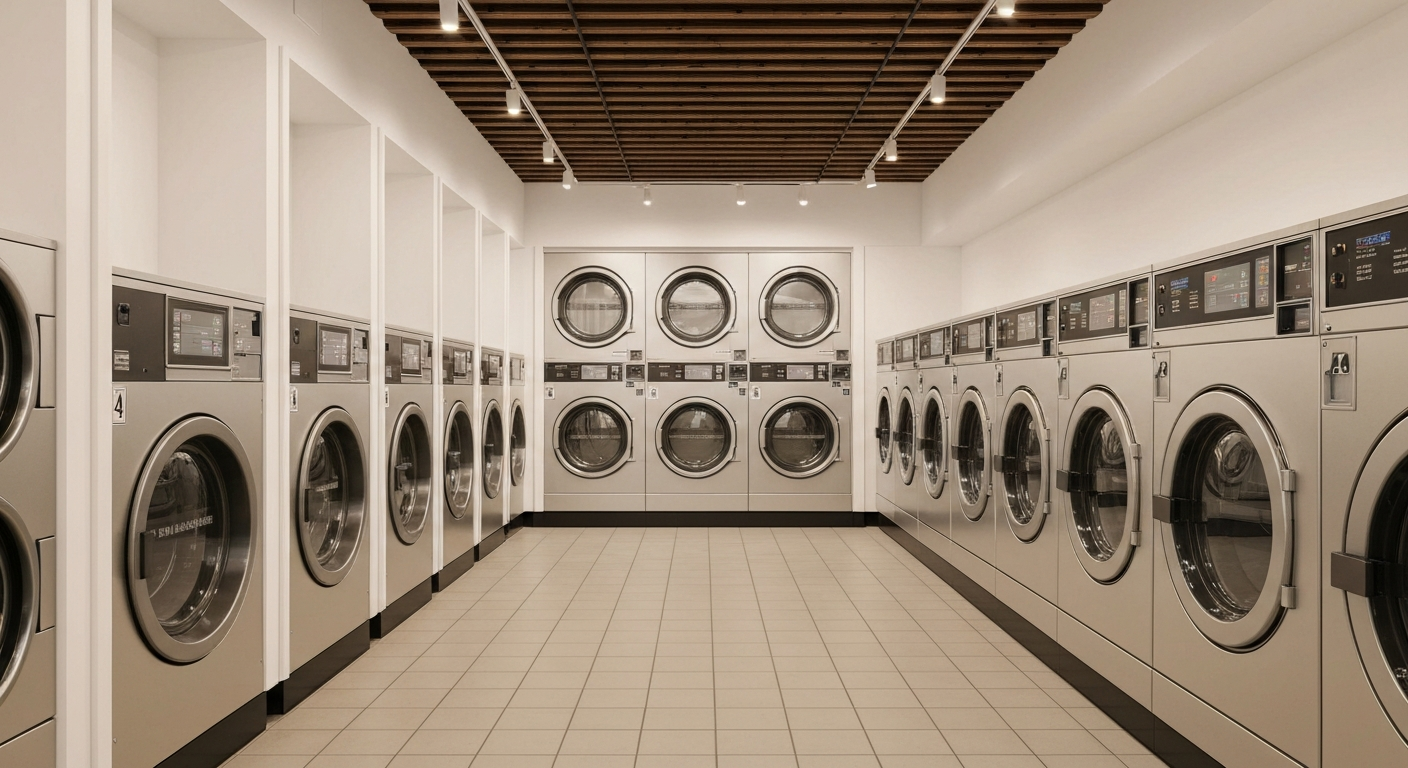
Expect to pay $800 to $5,000 per machine, depending on capacity and brand. Front-loaders are standard for laundromats — they’re more water-efficient and customers prefer them. A typical mid-size laundromat runs 20-40 washers in a mix of capacities: 18-lb, 30-lb, 40-lb, and sometimes 60-lb or 80-lb machines for bulky items.
The big commercial laundry brands — Speed Queen, Dexter, Maytag Commercial, Huebsch — are what you’ll see in most professional laundromats. Speed Queen and Dexter have strong distribution networks in Georgia and decent parts availability. Don’t buy residential machines. They’re not built for continuous commercial use and will fail constantly.
Buying used equipment is an option that can cut costs significantly, but only from reputable dealers who can verify machine history and offer some warranty coverage. Mystery-source used machines are a gamble.
Commercial Dryers
Commercial dryers run $800 to $3,000 each. You typically want a 2:1 or 3:2 dryer-to-washer ratio by capacity — dryers run shorter cycles, so you need fewer of them, but customers get frustrated if they can’t find an open dryer after their wash finishes.
Stack dryers are common in laundromats to maximize floor space. Gas dryers cost more to purchase but typically run cheaper than electric over time. In Georgia, where natural gas infrastructure is widespread, gas dryers are usually the right call.
Payment Systems
The industry has largely moved away from coin-only. Modern laundromats use card and app-based payment systems alongside or instead of coins. Expect to spend $2,000 to $10,000 for a payment system depending on scope — this includes card readers on machines, a management interface, and sometimes a central payment kiosk.
The upside of card systems is remote monitoring. You can see which machines are running, revenue in real time, and error alerts without being on-site. For a semi-passive business model, this matters a lot.
Water Usage
A laundromat is a serious water consumer. Plan for 10,000 to 30,000 gallons per day depending on your machine count and how busy you are. This isn’t a typo. A single commercial front-loader uses 15-30 gallons per cycle; multiply by 20-40 machines running all day.
Before finalizing a location, confirm with the municipal water authority that the service connection and infrastructure can handle that load. You also need water heating capacity — either a large commercial water heater or a tankless system sized appropriately. Undersizing your hot water capacity creates miserable customer experiences and kills your reviews.
Georgia Utility Costs
This is where Georgia’s geography helps your business model. Georgia Power’s commercial rates run below the national average, and natural gas through Atlanta Gas Light is competitively priced compared to states like California or New York. Water and sewer rates in most Georgia municipalities are also reasonable.
The difference adds up. A laundromat spending $8,000-$12,000/month on utilities in coastal California might spend $5,000-$8,000 in a comparable Georgia location. Over a year, that’s $36,000-$48,000 more margin. Lower lease rates in most of Georgia outside midtown Atlanta compound the advantage.
Startup Costs
Laundromats are capital-intensive. There’s no way around it. The flip side is that once you’re operational, the labor model is lean — a well-designed laundromat can run with minimal staff, with an attendant for part of the day and remote monitoring handling the rest.
Here’s the full picture of what you’re looking at:
LLC Formation
File your LLC with the Georgia Secretary of State at ecorp.sos.ga.gov. The fee is $100 online ($110 by mail). Annual registration runs $60/year ($50 base + $10 service fee), due between January 1 and April 1.
You want an LLC for liability protection. A machine malfunction, a slip-and-fall, a customer’s damaged clothing — you don’t want personal exposure. The $100 is the cheapest line item in this entire budget.
Equipment
The biggest number. $100,000 to $300,000 depending on size and whether you buy new or used. A small laundromat with 15-20 washers and dryers might come in toward the low end with used equipment. A full-size 40+ machine laundromat with new commercial equipment hits the upper end fast.
Don’t try to open with too few machines. A laundromat that’s constantly full with customers waiting will lose regulars who can’t count on getting in and out. Build enough capacity for your projected peak hours.
Build-Out
$50,000 to $150,000, sometimes more. This covers plumbing (the big one — multiple drain lines, hot and cold supply to every machine), electrical (high-amperage service, dedicated circuits), flooring, lighting, HVAC, seating, folding tables, signage, and any tenant improvements the space needs.
Plumbing and electrical are the expensive parts. A laundromat is essentially a utility-dense commercial space, and your contractor needs experience with this type of build-out. A general contractor who’s never done one will underestimate the complexity.
If you’re taking over an existing laundromat space, your build-out costs drop significantly — the plumbing is already roughed in. That’s worth a real premium on the lease.
Payment Systems
Budget $2,000 to $10,000 separately from your equipment costs. This includes card readers, a central kiosk if you’re using one, and the software subscription for remote monitoring. Some payment system providers will finance or lease the equipment, which reduces upfront outlay.
Insurance
$2,000 to $5,000 per year for a package that includes general liability, property/equipment coverage, and business interruption. Equipment is expensive and failure is when — not if. Business interruption coverage matters because if a major plumbing issue shuts you down for two weeks, you’re still paying rent and loan payments.
Get quotes from commercial insurance brokers familiar with laundry facilities. Standard small business policies sometimes exclude water damage at the level laundromats generate — read the policy.
Working Capital
$15,000 to $50,000 liquid to cover the first several months of operations. You will not hit full revenue on day one. Expect 3-6 months to build a customer base, work out operational kinks, and hit consistent revenue. Your working capital covers rent, utilities, supplies (detergent vending, laundry bags), and payroll during that ramp.
Under-capitalized laundromats fail not because the concept doesn’t work, but because the owner runs out of runway before the business stabilizes.
Total Investment
Add it up: $200,000 to $500,000+. Most small laundromats fall in the $200,000-$350,000 range. Larger operations or high-cost metro locations push toward the top.
SBA loans — particularly the SBA 7(a) and SBA 504 programs — are the most common financing route for laundromats. Lenders understand the model because laundromats have predictable cash flows and hard asset collateral (the equipment). You’ll still need 10-30% down, strong personal credit, and a solid business plan.
Location Is the Decision
Everything in this guide matters. But if you pick the wrong location, none of it saves you.
Laundromat demographics are specific. You want density of renters — not homeowners, who have their own machines. Apartment-dense neighborhoods, areas with older rental housing stock (older buildings less likely to have in-unit laundry), and corridors with good foot traffic and visible parking. In Georgia, you’re looking at neighborhoods inside the Atlanta perimeter, mid-size city corridors in Augusta, Savannah, Columbus, and Macon, and high-rental-density suburbs.
Visibility and parking matter more than you might think. A laundromat tucked behind another building with three parking spaces will underperform an identical laundromat in a strip mall with good signage. Customers are coming with bags of laundry. They’re driving.
Check what’s already there. A neighborhood with two established laundromats may not need a third. Or it may — look at whether the existing ones are well-maintained or neglected. A neglected laundromat in a good location is an opportunity, not competition.
Your Next Steps
Register your LLC at ecorp.sos.ga.gov — that’s $100 and handles your legal entity. Then contact your local city or county business licensing office to understand the exact Occupation Tax Certificate requirements in your target municipality, including the E-Verify and SAVE affidavit process.
While that’s in motion, start your location search and run the numbers on at least three specific spaces. Get a commercial real estate broker who works with retail tenants — their fee comes from the landlord, not you. And get your financing conversations started early. SBA loan approval takes time, and you want a lender lined up before you’re under contract on a lease.
The model works. Semi-passive, recession-resistant, and Georgia’s operating economics help. But this is a six-figure commitment before you open the doors — go in clear-eyed and capitalized.