How to Start a Landscaping Business in Georgia
How to Start a Landscaping Business in Georgia
Georgia’s lawn care and landscaping industry runs nearly year-round. That’s not a small thing. While competitors in Ohio or Michigan are staring at snow for four months, you’re still mowing, mulching, and installing sod in January. The longer revenue window is one of the best reasons to start here.
But here’s what catches most new landscapers off guard: Georgia doesn’t require a general landscaping license — and people misread that as “no licenses required.” Touch pesticides, sell plants, install irrigation, or disturb soil on a commercial site, and you’re immediately in regulated territory. Getting that wrong doesn’t just cost you a fine. It can kill a contract, expose you to liability, or get your business license pulled.
This guide covers everything specific to Georgia — the licenses that actually apply to landscaping, the E-Verify rules that trip up seasonal-labor businesses, and the costs you should plan for before you buy your first mower.
Why Start a Landscaping Business in Georgia
The fundamentals are genuinely good here.
Most of Georgia sits in USDA Hardiness Zones 6b through 9a. That means fescue lawns in the mountains and St. Augustine grass on the coast — and something growing in almost every county for ten months of the year or more. For a lawn care business, that’s direct revenue: more months of maintenance, more mowing cycles, more customers willing to pay for year-round programs.
The growth story also matters. Metro Atlanta keeps expanding into Cherokee, Hall, Forsyth, and Paulding counties. Savannah’s port-driven economy has pushed development into Bryan and Effingham counties. Augusta’s medical and military sectors generate steady residential construction. New construction creates two revenue streams simultaneously: the builder who needs initial grading and landscaping, and the homeowner who needs ongoing maintenance afterward.
What it actually costs to get started:
- Solo lawn care (mower, trailer, basic equipment): $8,000–$20,000
- Full-service landscaping (planting, mulching, basic hardscape): $25,000–$60,000
- Commercial-scale operation (large equipment, multiple crews): $75,000–$200,000
You don’t need to start at the top of that range. Most successful Georgia landscaping businesses started with one truck, one trailer, and a commercial mower.
Step 1: Choose Your Business Structure
Register an LLC. That’s the recommendation for almost every landscaping startup in Georgia, and the reasons are specific to the industry.
Landscaping carries more liability exposure than most service businesses. Equipment causes property damage — a rock through a window, a mower that clips a sprinkler head, a truck that ruts a driveway. Trees fall wrong. Employees get hurt. A customer slips on wet grass near your crew. None of those situations are rare, and all of them can become lawsuits. An LLC separates your personal assets — your house, your savings — from the business.
Filing is straightforward. Go to ecorp.sos.ga.gov, file your Articles of Organization online, and pay $100. Processing typically takes 5–12 business days. Need it faster? Pay $100 for 2-day expedited processing or $250 for same-day. After that, you’ll owe a $60 Annual Registration fee each year (due January 1 through April 1 — miss that deadline and you’ll pay a $25 late penalty).
Once your LLC is active, get your EIN from the IRS at irs.gov/ein. It’s free. Takes about ten minutes. You need it to open a business bank account and to hire employees — and you’ll almost certainly hire employees eventually.
Step 2: Understand Georgia’s Specialized Licenses
This is where most new landscapers make expensive mistakes. Here’s the line: basic services require no state license. The moment you cross into specific service categories, state licenses become mandatory.
What you can do without any state license
Basic mowing, edging, leaf removal, mulching, planting flowers and shrubs, trimming hedges — none of that requires a state license in Georgia. If you’re starting a straightforward lawn maintenance operation, you can legally operate with just your local business license (more on that in Step 3).
Pesticide application — the Category 24 license
This is the most commonly violated rule in the industry.
The second you offer weed control, fertilizer programs, grub treatment, or any form of pest management — even just spraying a customer’s lawn for weeds — you’re legally required to hold a Commercial Pesticide Applicator License from the Georgia Department of Agriculture. Specifically, Category 24: Ornamental and Turf Pest Control.
Many landscapers add fertilizer programs or weed control packages because the margins are good. Most don’t realize they just became illegal.
The licensing process requires passing a written exam. Costs break down like this:
- Exam fee: $45
- License fee: $25
- Pesticide Contractor License (required to operate the business): $55/year
- Total initial cost: approximately $125
Contact the Georgia Department of Agriculture at (404) 656-4950 or visit agr.georgia.gov for current exam schedules and application materials. Study materials are available through the Georgia Cooperative Extension — don’t skip the prep. The exam covers pest identification, application methods, and safety protocols.
Nursery Dealer’s License
If you purchase plants wholesale and sell or distribute them to customers as part of your landscaping work — sod, trees, shrubs, annuals — you need a Nursery Dealer’s License from the Georgia Department of Agriculture. This applies even if you’re not running a plant nursery. Buying plants and reselling them as part of a landscaping job counts.
Irrigation installation
Installing irrigation systems in Georgia requires a Low Voltage Contractor’s License. This is a separate licensing track — not a landscaping license, but a contractor license. If irrigation installation is part of your business model, plan for this before you start selling irrigation services.
Soil disturbance — the Level 1A Certificate
Here’s one that catches even experienced landscapers. Georgia’s Erosion and Sedimentation Act requires anyone disturbing land (grading, soil movement, drainage work) on commercial or larger residential projects to hold a Level 1A Soil Erosion and Sedimentation Certificate. The homeowner exemption that applies to DIY work does not apply to contractors. If your crew is moving soil, you need this certification.
Landscape design
One more hard line: selling landscape designs — actual design plans and drawings — requires a Registered Landscape Architect license in Georgia. That license comes through the Georgia Secretary of State’s Board of Landscape Architects at sos.ga.gov. You can absolutely discuss ideas with clients, recommend plants, and execute designs. But producing and selling design documents is a licensed profession. Don’t call yourself a landscape designer and sell plans without the credential.
Step 3: Get Your Local Business License
Georgia has no statewide business license. Licensing happens at the city or county level — what most Georgia municipalities call an Occupation Tax Certificate.
Where you file depends on where your business is physically located:
- In a city? File with city hall.
- In an unincorporated county area? File with the county.
Fees typically run $50–$200 per year, depending on the municipality. Some base it on gross receipts, some charge a flat fee, some do both. Call your local city or county government office to get the exact requirements before you assume.
The E-Verify requirement — mandatory, not optional
Georgia is serious about this. Under O.C.G.A. § 36-60-6, every business license application in Georgia requires an E-Verify Affidavit and a SAVE Affidavit. No exceptions based on business size.
The SAVE Affidavit (Systematic Alien Verification for Entitlements) verifies your lawful presence in the United States. It requires notarization and a Secure and Verifiable Document — a driver’s license, passport, or equivalent. This applies to you as the business owner.
The E-Verify Affidavit is where the landscaping industry specifically needs to pay attention.
Georgia’s landscaping businesses run on seasonal labor. That’s just the reality of the industry. But the E-Verify rules don’t flex for seasonal employment:
- 11 or more employees: You must register for the federal E-Verify program, obtain your user number, and include it in the affidavit.
- Fewer than 11 employees: You file an exemption affidavit instead.
Note that the employee count includes part-time and seasonal workers. A summer crew of 12 people triggers the full E-Verify requirement even if most of them are gone by November. If you’re scaling up for busy season, plan your E-Verify registration before you hit that threshold — not after.
Step 4: Insurance Requirements
Some of these are legal requirements. Some are practical requirements because no commercial client will hire you without them. Know the difference.
General liability insurance
Not legally mandated by Georgia state law, but effectively mandatory if you want to work. Any HOA, property management company, commercial property, or general contractor will ask for a certificate of insurance before signing a contract. General liability for a landscaping business typically runs $800–$2,000 per year, depending on revenue and services offered. Get at least $1 million per occurrence.
Workers’ compensation
Legally required once you have 3 or more employees — and Georgia counts part-time and seasonal workers in that number. This matters enormously for landscaping businesses, where a three-person crew is a standard starting configuration. The relevant regulator is the Georgia State Board of Workers’ Compensation.
Landscaping carries a higher class code rate (class code 0042) because the work involves equipment, outdoor exposure, and physical labor. Rates are set by NCCI and vary by payroll. Georgia’s rates run approximately 10% below the national median, which is some comfort. But this is still a meaningful cost — budget for it.
Commercial auto insurance
Georgia law requires commercial auto insurance for vehicles used in business operations. If you’re driving a truck to job sites — hauling a trailer, carrying a crew, transporting equipment — you need commercial auto coverage. Your personal auto policy won’t cover a work-related accident. This isn’t a gray area.
Equipment and inland marine insurance
Your equipment moves between job sites constantly. A commercial mower can cost $8,000–$15,000. A trailer full of equipment can easily represent $20,000–$40,000 in tools. Inland marine insurance covers equipment that travels, unlike standard property insurance that only covers items at a fixed location. For any landscaping business beyond the most basic solo operation, this coverage is worth the cost.
Step 5: Register for State Taxes
Register through the Georgia Tax Center at gtc.dor.ga.gov.
Sales tax
Georgia’s base state sales tax is 4%, with local rates adding another 3–5% — total effective rates typically land between 7–9% depending on your county. The taxability of landscaping services in Georgia depends on what you’re selling.
Pure services — mowing, trimming, design consultation — are generally not subject to sales tax. But when you sell tangible goods as part of a landscaping job (plants, mulch, sod, gravel), those materials may be taxable. The line between a taxable sale of goods and a non-taxable service can get complicated when you’re bundling both. When in doubt, register for sales tax and collect it on materials. An accountant with small business experience can help you work out the specifics for your service mix.
Employer withholding tax
If you’re hiring employees, register for employer withholding tax at the Georgia Tax Center before you cut your first paycheck. Georgia’s individual income tax is a flat 5.19% for 2025 (dropping to 5.09% in 2026 under HB 111). No local or city income tax anywhere in Georgia — that simplifies your payroll math compared to states where you’re withholding for multiple jurisdictions.
Costs at a Glance
Here’s what to budget before you start quoting customers:
| Item | Cost |
|---|---|
| LLC filing (one-time) | $100 |
| Annual Registration | $60/year |
| Local Occupation Tax Certificate | $50–$200/year |
| Pesticide Applicator License (if applicable) | ~$125 initial; $55/year renewal |
| General liability insurance | $800–$2,000/year |
| Workers’ comp (3+ employees) | Varies by payroll; higher for landscaping class code |
| Commercial auto insurance | Required if using vehicles for business |
| Equipment | $8,000–$200,000+ depending on scale |
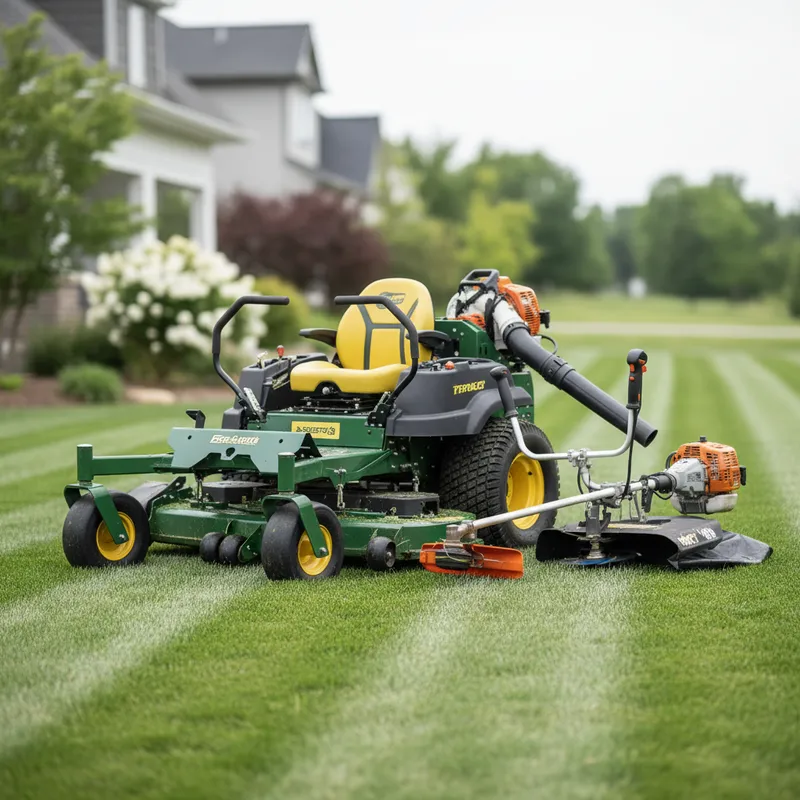
The licensing costs are actually modest. The equipment is where the real capital goes. A solo operation with a quality commercial mower, a trailer, blowers, and basic hand tools can get started under $20,000. But underestimating insurance — especially workers’ comp once you have a crew — is a common budget mistake.
The Licenses Most New Landscapers Miss
Worth repeating because these are genuinely common violations:
Category 24 pesticide license. You cannot legally apply pesticides — including herbicides for weed control, fertilizers classified as pesticides, or any lawn treatment product — without this license. Georgia Department of Agriculture enforces this. Fines are real, and operating without it voids your liability coverage for pesticide-related claims.
Nursery Dealer’s License. Buying plants wholesale and incorporating them into a landscape job counts as distribution. If you’re doing any volume of planting work, check whether you need this license before your next plant order.
E-Verify compliance. The landscaping industry’s seasonal hiring model creates specific risk here. Know your employee count, know the threshold, and register before you need to — not after someone asks.
Georgia’s landscaping regulations aren’t designed to block you from starting. They’re designed to separate businesses that operate professionally from those that don’t. Get the Category 24 license before you offer weed control. Get your workers’ comp in place before your third employee starts. Verify what your local municipality requires for the Occupation Tax Certificate.
The paperwork is manageable. Do it once, do it right, and then go build the business.