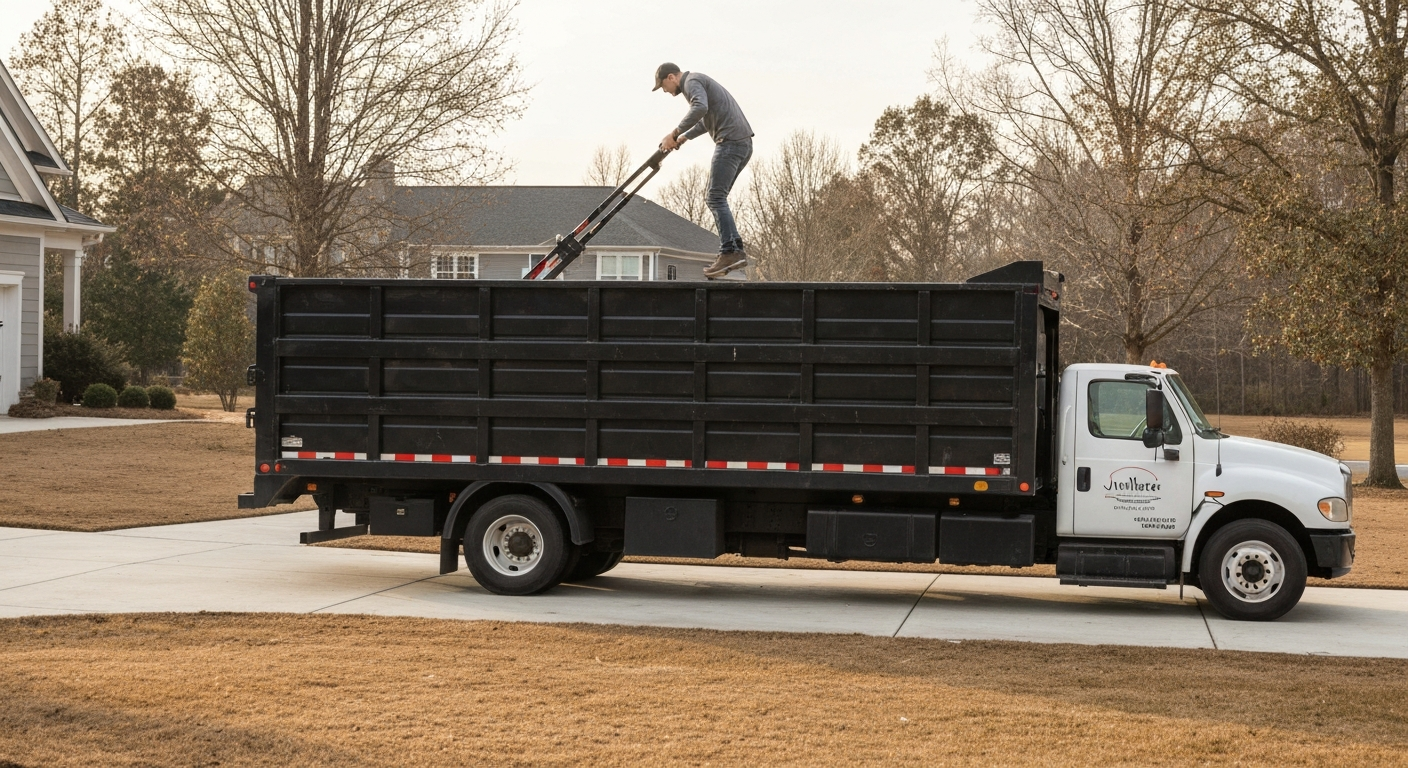
How to Start a Junk Removal Business in Georgia
How to Start a Junk Removal Business in Georgia
Georgia has no state license for junk removal. No certification, no board to petition, no exam to pass. You need a truck, a trailer, insurance, and a working knowledge of where your county sends its waste. That’s a shorter list than almost any other service business you could start.
The catch — and there’s always one — is that your margins live or die on disposal costs. A $400 job that sends 2 tons to the landfill at $65/ton leaves you with $270 before fuel, labor, and insurance. The same job, if you pull out the scrap metal, drop the old dresser at a Habitat ReStore, and recycle the cardboard, might cost you $30 in tipping fees instead of $130. That’s the skill set this business actually requires.
Here’s how to get licensed, insured, legal, and profitable.
Licensing Requirements
No State License — But Local Licensing Is Mandatory
Georgia doesn’t regulate junk hauling at the state level. There’s no licensing board, no state permit specifically for junk removal companies. What you do need is an Occupation Tax Certificate (sometimes called a business license) from every city or county where you operate. Most Georgia municipalities require this before you open your doors.
The fee varies. Smaller counties might charge $50-$75. Atlanta, Fulton County, and larger jurisdictions typically run $150-$300 or more, and some base the fee on estimated gross receipts — meaning it scales with your revenue. Call your city or county government directly to confirm the fee and renewal schedule.
E-Verify and SAVE Affidavits: The Part That Catches People Off Guard
Georgia has two mandatory requirements attached to every business license application that trip up new applicants who didn’t grow up here.
The E-Verify Affidavit (O.C.G.A. § 36-60-6): If your business has 11 or more employees, you must register for E-Verify and provide your employer user number when applying. If you have fewer than 11 employees — which covers most startup junk removal operations — you don’t register for E-Verify, but you must still file an exemption affidavit saying so. You can’t skip the paperwork just because you’re a one-person shop.
The SAVE Affidavit (O.C.G.A. § 50-36-1): This verifies your lawful presence in the United States. It requires notarization and a Secure and Verifiable Document — a passport, driver’s license, or similar qualifying ID. This applies to the business owner, not employees.
Both are required. Neither is optional. Show up to the county licensing office without them and you’re making a second trip.
Solid Waste Hauler Permits
Some Georgia counties require a separate solid waste hauler or transporter permit on top of the standard Occupation Tax Certificate. This isn’t universal — it depends entirely on your county. Cherokee, Cobb, and other counties with active waste management programs sometimes require registered haulers to carry specific permits to use county facilities.
Check with your county’s Public Works or Solid Waste Management department before your first load. The permit is usually low-cost or free, but operating without it can get your landfill access revoked, which is a bigger problem than the fine.
When a Contractor License Enters the Picture
Standard junk removal — hauling away furniture, appliances, yard debris, old flooring — doesn’t require a contractor license. But if a customer asks you to demo a deck, pull out a load-bearing wall, or do anything that looks like construction before you haul, you’re in different legal territory.
Georgia requires a state General Contractor license for construction projects valued over $2,500. That license requires passing the NASCLA exam, the Business and Law exam, proof of $500,000 general liability insurance per occurrence, and a $210 application fee. Most junk removal operators stay below this threshold intentionally. If you get into cleanout work that involves real demolition, you’ll need to either refer that work out or get licensed.
Waste Disposal
This is the part of the business most people underestimate before they start. You don’t just need a truck — you need to know what goes where, what it costs, and what you legally cannot accept.
County Landfills and Transfer Stations
Standard household junk — furniture, appliances, clothing, general clutter — goes to a licensed county landfill or transfer station. Most counties have at least one, and some have several. You’ll need to set up an account or simply pay per load.
Tipping fees in Georgia typically run $40-$70 per ton, though this varies meaningfully by county. Some counties charge by weight; others by load size (a pickup truck load versus a full trailer). Call the facility directly and ask for their commercial hauler rate schedule before you price your first job. If you’re in DeKalb County versus rural Meriwether County, you may be looking at very different numbers.
You’ll want to weigh your truck before and after a few loads to understand actual tonnage — bathroom-scale estimates will undercut your pricing fast.
Construction and Demolition Debris
Construction and demolition (C&D) debris — concrete, drywall, lumber, roofing shingles — often cannot go to the same facility as household waste. Georgia has licensed C&D landfills that accept this material, and some county facilities have separate C&D sections with different tipping fees. If you’re doing post-construction cleanouts or handling renovation debris, know which facility accepts what before you load the trailer.
Mixing C&D waste with household garbage can result in rejection at the gate or additional fees. Separate loads when possible.
Hazardous Materials
This is a hard stop. You cannot haul hazardous materials to a standard landfill, and accepting them without proper licensing creates serious liability. The list includes:
- Paints and solvents
- Pesticides and herbicides
- Motor oil and automotive fluids
- Propane tanks
- Batteries (certain types)
- Fluorescent bulbs containing mercury
When a customer has hazardous items, refer them to their county’s Household Hazardous Waste (HHW) program. Most Georgia counties run free HHW collection events or permanent drop-off sites. It’s not your job — and legally, it can’t be unless you’re licensed to handle it.
The Margin Play: Recycling and Donation
This is where smart operators separate themselves from average ones.
Scrap metal is cash. Copper, aluminum, steel — all of it has value at a scrap yard. A single old washing machine might offset the tipping fees for an entire load. Pull appliances out and separate metal before you hit the landfill.
Furniture in decent condition can go to Habitat for Humanity ReStores, Salvation Army, Goodwill, or local nonprofits. Some will pick up, some won’t — but even driving across town to donate a sofa instead of dumping it can save $20-$40 in tipping fees. At volume, that adds up fast.
Cardboard, clean paper, and certain plastics have recycling streams. Mattresses are harder — some counties have recycling programs, others don’t.
The operators who build real margin in this business aren’t just haulers. They’re sorters. Every item that doesn’t go to the landfill is money back in your pocket.
Business Structure and Costs
Form an LLC
You don’t legally have to form an LLC to operate a junk removal business in Georgia. But you absolutely should.
This work involves heavy equipment, labor, property damage risk, and physically entering people’s homes. A sole proprietorship means your personal assets are on the line if something goes wrong. An LLC creates a legal separation between your business and your personal finances.
File online at ecorp.sos.ga.gov. The filing fee is $100. After that, Georgia requires an Annual Registration — $50 fee plus a $10 mandatory service charge, totaling $60/year, due between January 1 and April 1. Miss the April 1 deadline and you’re looking at a $25 late penalty.
You’ll also need a registered agent with a physical Georgia address. You can serve as your own if you have a Georgia office, or hire a service for $50-$200/year.
Get an EIN
An Employer Identification Number is free from the IRS at irs.gov/ein. You need it to open a business bank account, hire employees, and handle taxes properly. Takes 10 minutes online.
Insurance
Don’t skip this or buy the bare minimum. Junk removal has real exposure: damage to client property, injuries on job sites, accidents with a loaded trailer.
General liability insurance covers property damage and bodily injury claims not related to your vehicles. Budget $800-$2,000/year for a startup operation. The actual number depends on your revenue, number of employees, and coverage limits.
Commercial auto insurance is separate from your personal auto policy and required any time you’re using a vehicle for commercial purposes. A personal policy won’t cover an accident in a work truck. Get commercial auto.
Workers’ compensation becomes legally required in Georgia once you have three or more employees — and that count includes officers and part-time workers. The Georgia State Board of Workers’ Compensation (sbwc.georgia.gov) oversees compliance. Don’t wait until you’re audited to sort this out.
Combined, expect to spend $2,000-$5,000/year on insurance as a small operator, more as you add trucks and employees.
Taxes
Georgia’s individual income tax rate is 5.19% in 2025 (dropping to 5.09% in 2026 under HB 111). If your LLC is taxed as a pass-through, that’s the state rate hitting your profits. If you elect corporate taxation, the Georgia corporate income tax rate is 5.75%.
Register for any applicable state taxes through the Georgia Tax Center at gtc.dor.ga.gov. Junk removal services are generally not subject to Georgia sales tax — you’re providing a service, not selling goods — but confirm with a CPA, because the rules can get nuanced if you’re reselling salvaged items.
Startup Costs at a Glance
Here’s what a lean Georgia junk removal startup actually costs, with no padding:
| Item | Estimated Cost |
|---|---|
| LLC filing (Georgia) | $100 |
| Annual registration | $60/year |
| Occupation Tax Certificate | $50–$300 (varies by county) |
| Dump trailer (14-16 ft) | $3,000–$15,000 |
| Work truck | $10,000–$30,000 |
| Insurance (GL + commercial auto) | $2,000–$5,000/year |
| Marketing (website, Google Business, door hangers) | $1,000–$3,000 |
| Total lean startup | $15,000–$35,000 |
The truck is your biggest variable. A used F-250 or F-350 with 150,000 miles gets the job done while you build your route. A newer truck with a 20-foot trailer looks more professional on job sites and holds more per haul — which matters when you’re pricing by the load, not by the hour.
The marketing number assumes you’re building an online presence from scratch. Google Business Profile is free and should be your first move. Junk removal is a high-intent search category — people who need a couch gone today are searching today. A basic website, some Google reviews, and a few hundred dollars in Google Local Services ads can generate real volume quickly.
The Path From First Load to Profitable Route
Start solo. One truck, one trailer, you in the cab. Price your first few jobs conservatively — you’re learning how long loads actually take, what the tipping fees are at your county facility, and how to sort material efficiently. Don’t hire until you have consistent demand you can’t handle alone.
Know your numbers before you quote. Your baseline cost per job is: fuel + tipping fees + labor (your time has value) + a prorated share of insurance and equipment. Quote below that and you’re paying to work. Most operators price by load volume — quarter load, half load, full trailer — with premiums for heavy items like concrete or appliances.
The first 90 days are about reviews and referrals. One clean, on-time job with a competitive price turns into five jobs if you ask for a Google review and follow up. Real estate agents, property managers, and estate attorneys are high-volume referral sources once you’ve proven reliable.
The business scales simply: add a truck, add a helper, add more routes. Georgia’s population density in the metro Atlanta ring, combined with active real estate turnover and a steady stream of estate cleanouts, creates reliable demand. The barrier to entry is low. That’s an opportunity — as long as you understand that every ton you keep out of the landfill is profit you’re manufacturing from someone else’s junk.