How to Start an HVAC Business in Georgia
How to Start an HVAC Business in Georgia
Georgia doesn’t just hand you a contractor license and wish you luck. Before you can legally run an HVAC business here, you need a Conditioned Air Contractor license — and the experience requirements are more specific than almost any other state in the country. That’s actually good news if you’ve put in your years. It means your competition had to earn their license too.
Here’s what the path looks like from where you’re standing to opening day.
Georgia Conditioned Air Contractor License
Georgia calls HVAC licensing what it is: conditioned air. The Georgia State Board of Conditioned Air Contractors, operating under the Secretary of State, issues two license classes.
Class I (Restricted) covers systems that don’t exceed 175,000 BTU heating capacity or 60,000 BTU cooling capacity. In practical terms, that’s residential work — single-family homes, small multi-family units, light residential replacement jobs. If your plan is to build a residential service and installation company, Class I gets you there.
Class II (Unrestricted) covers everything. Any system, any size, residential or commercial. Large commercial rooftop units, industrial process cooling, hospital HVAC systems — all of it falls under Class II. If you want to bid commercial work or grow beyond residential, this is the license you need.
Both classes are administered by the Georgia State Board of Conditioned Air Contractors. Applications go through the GOALS online portal — Georgia’s occupational licensing system run by the Secretary of State. You must be at least 18 years old and hold a high school diploma or GED to apply for either class.
One important note: the license attaches to the person, not the business. You’re the qualifying licensee. Your company operates under your license, which means your name and credentials are on every job your company does.
Experience and Education Requirements
This is where Georgia gets granular — and honestly, it’s the section that trips people up most.
Class I Requirements
Four years of documented HVAC experience. But not just any four years. The board breaks it down into three specific categories, and you need to hit all three:
2 years as a residential installation lead mechanic. Not helper work. Not assisting. You need to have been the lead on residential installs — running duct systems, setting equipment, making the calls. This is the work that demonstrates you can actually do the job, not just hand tools to someone who can.
1 year as a service technician with EPA certification. The EPA Section 608 certification isn’t optional here — it’s a prerequisite for this portion of your experience to count. You need to have been actively diagnosing and repairing systems, handling refrigerants under certification, during this year. If you did service work before you got your 608, that time doesn’t qualify.
1 year of residential supervisory experience. You need to have been overseeing other workers on residential HVAC projects. This doesn’t require you to have owned a business — supervising a crew as a foreman or lead supervisor for a licensed contractor qualifies.
All of this experience must be documented and verified. The board requires three notarized professional references from people who can vouch for your work — licensed architects, engineers, building inspectors, or licensed conditioned air contractors. These aren’t character references. They’re attestations of your specific experience. Choose people who actually watched you work.
ACCA Manuals D and J coursework is also required — a board-approved course covering heat loss/gain calculations (Manual J) and duct design (Manual D). This is a Georgia-specific requirement that not many other states mandate at the licensing level. It’s not just a checkbox. Manual J load calculations and Manual D duct sizing are the foundation of a properly designed HVAC system, and the board wants to know you understand them before you’re signing off on installations. Find a board-approved provider — some HVAC trade associations and community colleges offer the course.
Finally, a background check from local law enforcement is required. Not a national background check service — local law enforcement. Plan for this to take a few weeks.
Class II Requirements
Class II requires five years of documented experience with an emphasis on commercial and industrial HVAC systems. The same principles apply: documented, notarized, and verified. The board wants to see that you’ve actually worked on the larger, more complex systems that Class II authorizes you to install and service.
The EPA certification requirement carries over. If you’re doing commercial work with refrigerants, Type II certification (or Universal) is the minimum — and practically speaking, Universal certification is the right call if you’re building a business that touches any refrigerant type.
Exam and Application Costs
Once your application is complete and accepted, you’ll schedule and sit for the licensing exam.
Application fee: $110, submitted through the GOALS portal when you apply. This is non-refundable.
Exam fee: $267, paid directly to PSI/AMP, Georgia’s testing provider. You schedule the exam through them after your application is approved. The exam tests your knowledge of HVAC systems, installation practices, codes, and business practices relevant to conditioned air contracting.
Passing score: 70%. Study the Georgia State Minimum Standards for HVAC, relevant sections of the International Mechanical Code, and load calculation principles. There are prep courses available specifically for this exam — worth the investment if you’ve been in the field and haven’t cracked a code book recently.
License renewal: $75 every two years. Straightforward.
Continuing education: 4 hours per year. You’ll need to complete four hours of approved continuing education annually to maintain your license. This isn’t a heavy lift — most HVAC associations offer qualifying courses.
Total cost to get licensed, before you ever buy a tool or open a business: $377 in fees, plus whatever you spend on the ACCA coursework and exam prep.
Business Formation and Insurance
The license is the hardest part. The business formation is paperwork.
Form the LLC
An LLC gives you liability protection and a clean separation between your personal finances and the business. File online at ecorp.sos.ga.gov — the Georgia Secretary of State Corporations Division portal. Filing fee is $100. Annual registration runs $60 per year (that’s a $50 base fee plus a mandatory $10 service fee, effective September 6, 2025), due between January 1 and April 1 each year. Miss the April 1 deadline and you’re looking at a $25 late penalty.
Get your EIN from the IRS immediately after formation — it’s free at irs.gov/ein and takes about ten minutes online.
Occupation Tax Certificate
Georgia doesn’t have a statewide business license. What you need is a local occupation tax certificate from the city or county where your business operates. Every county and city has its own process and fee schedule — check with your local government directly.
Two things you cannot skip for this application: the E-Verify affidavit and the SAVE affidavit. These are mandatory under Georgia law (O.C.G.A. § 36-60-6 and O.C.G.A. § 50-36-1).
The E-Verify requirement depends on your employee count. If you have 11 or more employees, you must register for E-Verify and provide your user number. If you have fewer than 11 employees, you file an exemption affidavit instead. Either way, you’re filing something.
The SAVE affidavit verifies your lawful presence in the US. It requires notarization and a secure and verifiable document. Don’t show up to the county office without it — you won’t get your certificate.
Insurance
HVAC work carries real liability. You’re dealing with refrigerants, gas lines, electrical connections, and expensive equipment installed in people’s homes and businesses. Insurance isn’t optional, and the minimum limits aren’t suggestions.
General liability insurance: $500,000 to $1,000,000 per occurrence is the standard range for HVAC contractors. Get at least $1 million if you’re bidding any commercial work — most general contractors and property managers won’t even look at a subcontractor under that threshold.
Workers’ compensation insurance is legally required in Georgia once you have three or more employees. That count includes officers, part-time workers, and seasonal employees. The Georgia State Board of Workers’ Compensation administers this — sbwc.georgia.gov. Budget for it from day one if you’re planning to hire even one person, because three workers comes faster than you think.
Commercial auto insurance for your service vehicles. Personal auto policies don’t cover business use. If your van is in an accident on the way to a job call, a personal policy will deny the claim. Every vehicle in your fleet needs commercial coverage.
Total insurance budget: $5,000 to $15,000 per year, depending on your revenue, crew size, and coverage limits. The range is wide because a solo operator with one vehicle and residential-only work sits at the low end, and a multi-tech operation with commercial clients and multiple vehicles sits at the high end.
Startup Costs at a Glance
Here’s what you’re actually looking at to get from licensed technician to operating business:
| Item | Cost |
|---|---|
| LLC filing fee | $100 |
| Annual registration | $60/year |
| License application fee | $110 |
| Exam fee (PSI/AMP) | $267 |
| EPA 608 certification | $20–$200 |
| Occupation tax certificate | Varies by county/city |
| General liability + commercial auto insurance | $5,000–$15,000/year |
| Service vehicle with basic equipment | $30,000–$60,000 |
| HVAC tools, gauges, recovery equipment | $5,000–$20,000 |
Realistic total for a solo Class I startup: $15,000–$35,000, assuming you already have your EPA certification and some tools, and you’re buying a used service vehicle. If you need a newer truck and a full tool setup from scratch, you’re at the higher end or beyond it.
A few notes on those ranges:
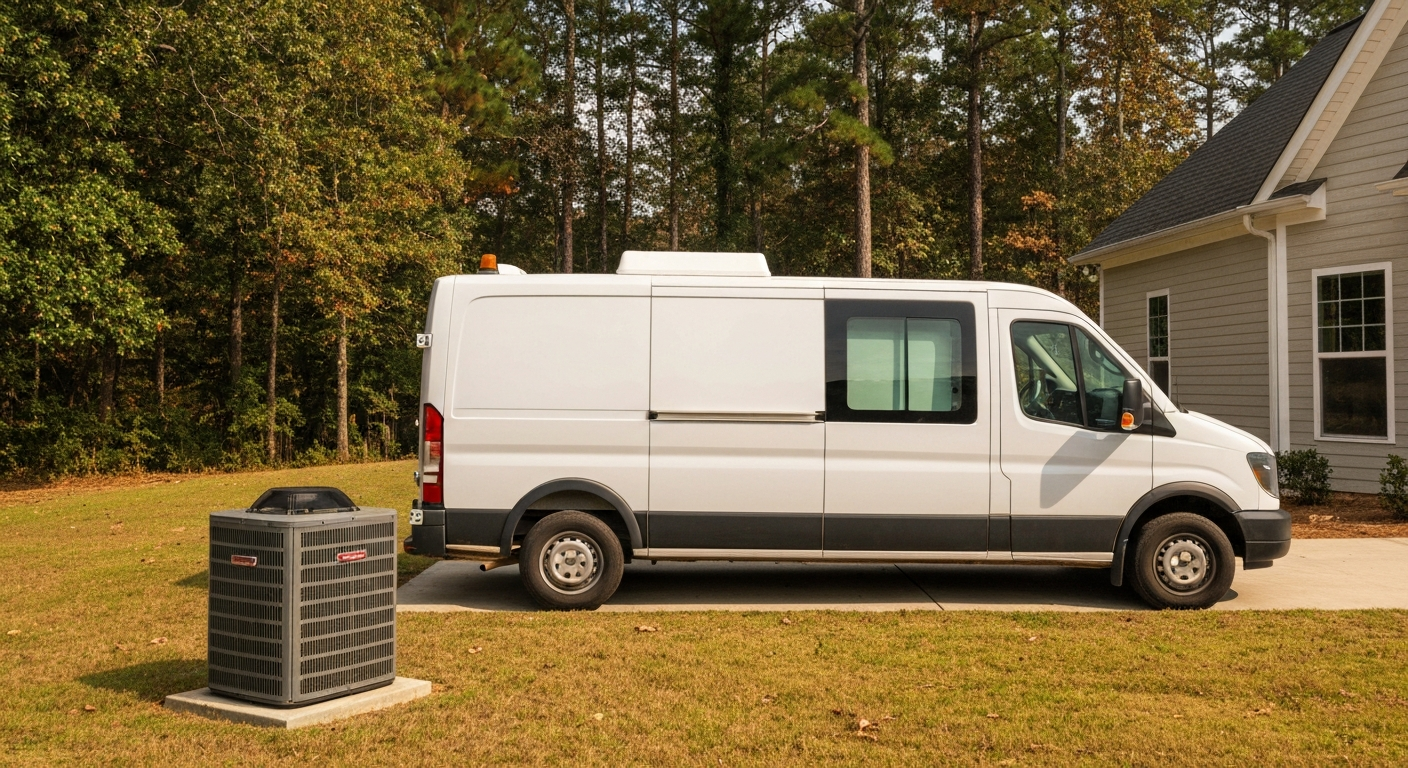
The vehicle is usually the biggest variable. A used work van or truck in decent shape can run $15,000–$25,000. A newer vehicle with branding and built-out shelving can push $50,000–$60,000. Buy what gets the job done reliably — a breakdown on a 95-degree July day in Atlanta costs you more than the price difference between a good used vehicle and a great new one.
Recovery equipment, manifold gauges, micron gauges, vacuum pumps, and refrigerant handling equipment add up fast. Don’t shortcut here. Cheap gauges fail at the worst moments, and EPA refrigerant handling violations carry fines that hurt.
EPA 608 certification cost varies because it depends on where you test. Some employers pay for it, trade school programs include it, and standalone testing can run $20 to $200. If you’ve already got your Universal certification, cross that line item off.
The Realistic Timeline
Expect three to six months from application submission to license in hand. The background check and reference verification take time. If your GOALS application has any gaps in documentation, the board will send it back and the clock resets.
Here’s a practical sequence: Get your EPA certification first if you don’t have it. Complete the ACCA Manuals D and J course. Line up your three notarized references before you apply — don’t wait until the application asks for them. Submit your application with every document complete. Schedule your exam as soon as the board approves your application.
While you’re waiting on the exam and license, form the LLC, get the EIN, and start shopping insurance quotes. Insurance underwriters will want to know your licensing status, but you can get preliminary quotes and have coverage ready to bind the day your license arrives.
Start talking to suppliers too. Setting up accounts with a local HVAC distributor — Winsupply, Johnstone Supply, Ferguson, whoever is in your market — takes time, and you want terms established before your first job requires a next-day equipment order.
Your license is the hard part. Everything else is just executing a checklist. Get that piece right, and the rest follows.