How to Start a Hair Salon Business in Georgia
How to Start a Hair Salon in Georgia
Georgia has more than 14,000 licensed cosmetologists and a hair care industry that stays busy regardless of what the economy does. If you’re thinking about opening a salon, the market is real. But so is the paperwork.
Here’s what most people don’t realize going in: opening a hair salon in Georgia requires two separate licensing tracks running simultaneously. You need a salon/shop license from the Georgia State Board of Cosmetology and Barbers. And you need a local business license (called an Occupation Tax Certificate) from your city or county. These are entirely different applications, filed with different agencies, with different requirements. Neither one substitutes for the other.
Add in Georgia’s mandatory E-Verify and SAVE affidavit requirements, and you’ve got a checklist that’s longer than most people expect. None of it is impossible — but skipping steps or doing them out of order will delay your opening or, worse, get you operating illegally.
This guide covers both tracks, plus the build-out realities and staffing math.
The Georgia Salon/Shop License
This is the license that actually authorizes your physical location to operate as a hair salon. It comes from the Georgia State Board of Cosmetology and Barbers, which sits under the Secretary of State’s office at sos.ga.gov.
The application fee is $75, non-refundable, payable by check or money order. Not credit card — check or money order. This catches people off guard.
What goes in the application package:
Beyond the form and the fee, every owner must complete a separate notarized Owner Affidavit accompanied by a Secure and Verifiable Document. The Secure and Verifiable Document is a government-issued ID that meets the criteria under O.C.G.A. § 50-36-1 — think passport, driver’s license, or permanent resident card. The affidavit must be notarized. Not signed. Notarized. If you have multiple owners, each owner submits their own.
You’ll also need to include a Bill of Sale or a copy of your lease — specifically the pages showing the location address and the signature pages. This confirms you actually have control of the physical space before the board approves a license for it.
The critical timing rule: Georgia law requires that your salon/shop license be issued before you open or begin any work on clients. Not applied for. Not pending. Issued. Operating without it isn’t a technicality — it’s illegal. Build your opening timeline backward from when you realistically expect the license in hand, not from when you sign your lease.
Once you have the license, display it in a conspicuous place inside the salon. The board’s inspectors will look for it.
One more thing worth knowing: you do not need to be a licensed cosmetologist to own a salon in Georgia. The ownership license and the individual service license are separate things entirely. You can own the business without ever having touched a pair of shears — but every single person performing services in your salon must hold their own valid individual license. More on that below.
Cosmetologist License Requirements
If you’re opening a salon and also planning to do hair yourself, you need both the salon/shop license and your own cosmetologist license. Same if any of your employees or booth renters plan to work behind the chair.
Georgia requires one of two training paths:
Option 1: Cosmetology school. 1,500 hours of training at a state-approved school, which works out to a minimum of 9 months. This is the path most people take.
Option 2: Apprenticeship. 3,000 hours under a licensed cosmetologist, minimum 18 months. Longer, but viable if you’re learning in a working salon environment.
Age requirements: you must be at least 17 years old to enroll in cosmetology school (16 for the apprenticeship path). You also need a high school diploma, GED, or higher education credential. No exceptions.
After completing training, you pass two exams — a written theory exam and a practical skills exam. Both must be passed before the board issues your individual license.
Then it doesn’t stop there. Cosmetology licenses in Georgia require continuing education for annual renewal. The CE hours keep your skills current and your license active. If you’re hiring stylists, their renewal status is your problem too — an employee with a lapsed license is an unlicensed operator in your shop, which reflects on your salon license.
Keep a copy of every employee’s current license on file. Verify renewal dates. This is one of those administrative habits that saves real headaches during a board inspection.
Business Structure and Local Licensing
The salon/shop license covers your operation with the state board. It doesn’t cover your general business registration or your local operating permit. Those are separate, and you need them too.
Step 1: Form your business entity.
Most salon owners go with an LLC. In Georgia, you file online at ecorp.sos.ga.gov for $100. The process is straightforward — you pick a name, designate a registered agent, and submit your Articles of Organization. You’ll also pay $60/year for the Annual Registration (that’s a $50 fee plus a mandatory $10 service fee, effective September 6, 2025), due between January 1 and April 1 each year. Miss that deadline and you’re looking at a $25 late penalty.
A sole proprietorship costs nothing to form, but an LLC gives you liability separation between your personal assets and the business. For a salon — where you have clients, employees, and physical equipment — that protection is worth the $100.
Step 2: Get an EIN.
Free at irs.gov/ein. Takes about five minutes. You need it to open a business bank account, hire employees, and handle taxes.
Step 3: Local Occupation Tax Certificate.
Georgia has no statewide general business license. Instead, your city or county issues an Occupation Tax Certificate (sometimes called a business license). You apply through your local government — either the city if you’re within city limits, or the county if you’re in an unincorporated area.
Here’s where Georgia’s E-Verify and SAVE requirements come in.
Every business license application in Georgia requires:
- E-Verify Affidavit: If you have 11 or more employees, you must be registered with E-Verify and provide your user number. If you have fewer than 11 employees, you still have to file an exemption affidavit. This is required under O.C.G.A. § 36-60-6. No exceptions, no “we’ll add it later.”
- SAVE Affidavit: Under O.C.G.A. § 50-36-1, you must verify your own lawful presence in the United States using a Secure and Verifiable Document. Same document type used for the salon license Owner Affidavit — but this is a separate filing for the local business license.
If you’re confused about why you’re signing similar affidavits for two different agencies, that’s because they genuinely are two different requirements tied to two different licenses. The board’s notarized Owner Affidavit and the local SAVE Affidavit both involve Secure and Verifiable Documents, but they’re not interchangeable.
Get both done. Don’t assume one satisfies the other.
Also register for taxes.
If you’re selling retail products — shampoo, styling products, anything a client buys to take home — you need to collect sales tax. Register through the Georgia Tax Center at gtc.dor.ga.gov. Georgia’s base sales tax rate is 4%, but local rates stack on top. Total combined rates typically run 7–9% depending on your county. Check your specific location.
Build-Out and Startup Costs
The license fees are the smallest part of your budget. Here’s what you’re actually spending to get a salon open.
LLC filing: $100 one-time, plus $60/year for the Annual Registration.
Salon/shop license: $75. Low fee, but the notarization and document requirements add time and administrative friction — factor in at least 2–4 weeks for processing.
Occupation Tax Certificate: Varies by locality. Some cities charge under $100; others charge based on gross receipts or number of employees. Call your city or county business office for the exact figure.
Salon build-out: $20,000–$75,000. This is the widest range and the biggest variable. Taking over an existing salon space already plumbed for shampoo bowls is dramatically cheaper than building out raw commercial space. If you’re inheriting a salon layout, you might hit the low end. Starting from a blank retail box, you’ll be closer to $75,000.
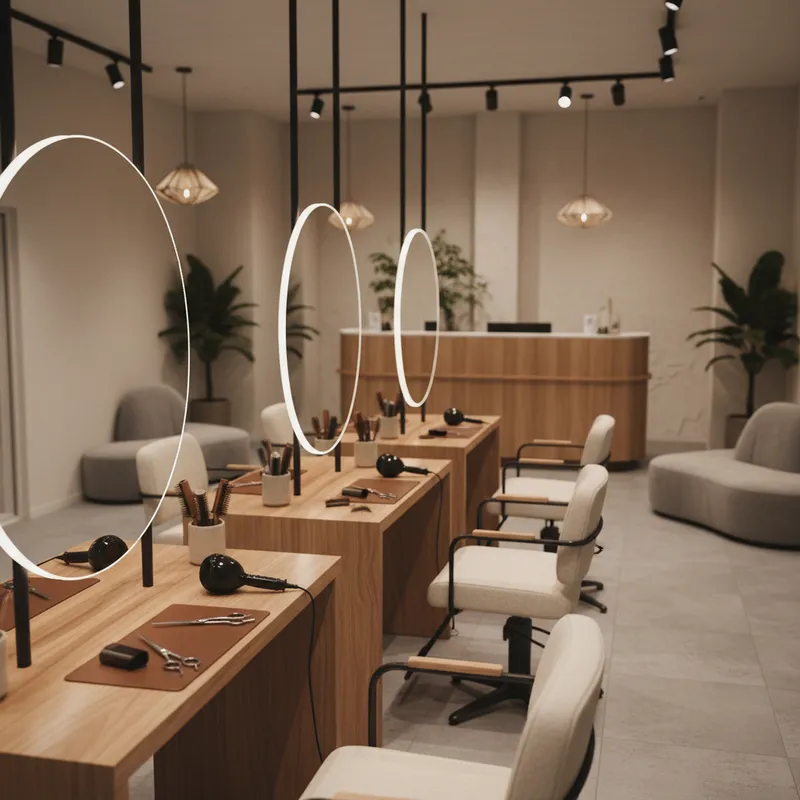
Styling stations: $5,000–$15,000 for a full set. A quality hydraulic styling chair runs $400–$900 each. Add the stations themselves, mirrors, and lighting, and a 4-station setup costs real money.
Product inventory: $2,000–$5,000 to stock retail products and working inventory (color, treatments, styling products). Build a relationship with a distributor early — professional-grade product access and pricing depends on it.
Insurance: $1,500–$4,000/year. You need general liability at minimum. If you’re doing chemical services, make sure your policy covers that specifically — some basic GL policies exclude professional services. Consider adding property coverage for your equipment.
Workers’ compensation note: Georgia requires workers’ comp coverage once you have 3 or more employees. That includes part-time workers and officers. Don’t wait until you’re adding a third chair to sort this out — the Georgia State Board of Workers’ Compensation (sbwc.georgia.gov) oversees compliance.
Total lean startup estimate: $35,000–$70,000. That’s assuming you’re not paying yourself a salary during buildout, you’re negotiating a reasonable lease, and you’re not over-building the space before you have a client base.
Booth rental model or commission-based? That affects your cash flow projections significantly. Booth renters pay you a flat weekly or monthly rate regardless of what they earn. Commission splits mean your revenue scales with the stylists’ production. Neither is objectively better — it depends on how much management overhead you want and how much revenue uncertainty you can absorb in the early months.
The Timeline You Actually Need
Here’s how these pieces sequence in practice:
- Secure your location. Sign a lease or execute a Bill of Sale. You need this document for the salon/shop license application.
- Form your LLC at ecorp.sos.ga.gov ($100). Get your EIN from irs.gov.
- Submit the salon/shop license application to the Georgia State Board of Cosmetology and Barbers — $75, notarized Owner Affidavit, Secure and Verifiable Document, lease copy included. Wait for the license to be issued.
- Apply for your local Occupation Tax Certificate with E-Verify and SAVE affidavits in hand.
- Register for sales tax at gtc.dor.ga.gov if you’re selling retail.
- Verify all employee/booth renter licenses before anyone starts working.
- Open only after the salon/shop license is in hand. Not before.
That sequence matters. The board won’t approve a license without proof of your location. The local business license needs your entity information. And no one touches a client until the salon license is posted on the wall.
Start the license application as soon as your lease is signed. Don’t wait until your chairs arrive.
The Bottom Line
The $75 salon license fee is genuinely low. The process around it is not. Between the notarized Owner Affidavit, the Secure and Verifiable Document requirement, the lease copy, the separate local E-Verify and SAVE filings, and the must-have-before-opening rule, Georgia’s salon licensing has more administrative steps than most first-time owners anticipate.
None of it is hard. All of it is mandatory.
Start the Georgia State Board application the day you sign your lease. Get your LLC filed the same week. Track your stylists’ individual license renewal dates like they’re your own. And don’t schedule your opening date until the license is physically issued.
The Georgia State Board of Cosmetology and Barbers can be reached through sos.ga.gov. For questions about local business licensing, contact your city or county directly — requirements and fees vary enough that you need the specific numbers for your location.