How to Start a Chiropractic Practice in Georgia
How to Start a Chiropractic Practice in Georgia
Georgia has a standalone Board of Chiropractic Examiners — not a committee tucked under the Board of Medicine like in many states. That distinction matters. It means chiropractic licensing in Georgia operates on its own track, with its own requirements, its own portal, and its own standards. If you’re a licensed chiropractor ready to open your own practice here, or a new graduate mapping out the path, here’s exactly what you need to do.
Chiropractic License
Your first stop is the Georgia Board of Chiropractic Examiners, which operates under the Secretary of State’s office. Everything runs through sos.ga.gov — the professional licensing section.
Education requirement. You need a degree from a college accredited by the Council on Chiropractic Education (CCE). If your school isn’t CCE-accredited, Georgia won’t accept your application. Full stop. Check your school’s accreditation status before assuming you qualify.
Examinations. Georgia requires you to pass all four parts of the National Board of Chiropractic Examiners (NBCE) exam — Parts I, II, III, and IV. That’s the baseline almost every state requires. But Georgia adds one more: a state jurisprudence exam specific to Georgia law and chiropractic practice regulations. This isn’t a formality. It covers Georgia statutes, the state’s scope of practice rules, and the Board’s own regulations. Study it like any other board exam.
The NBCE exams are administered by the national board. The Georgia jurisprudence exam is handled separately through the state licensing process.
Application. Once your education and exams are squared away, you apply through the SOS Professional Licensing portal at sos.ga.gov. You’ll submit your transcripts, NBCE scores, exam attestations, and application fee. The Board reviews everything before issuing your license. Don’t schedule your practice lease or equipment purchases until you have the license in hand — the Board’s review timeline can stretch several weeks.
One thing to know: Georgia doesn’t require a separate facility license for a chiropractic office. Unlike some healthcare settings that need a state-issued facility permit on top of the practitioner license, a chiropractic practice just needs your individual license plus the standard local business credentials. That’s a real simplification compared to, say, a home health agency or a dental surgery center.
Professional Practitioner Tax Option
Here’s something most new practice owners miss, and it can save you real money.
Georgia law — specifically O.C.G.A. § 48-13-9(c) — gives licensed professionals, including chiropractors, the option to pay a flat $400 per practitioner occupation tax instead of the standard gross-receipts-based occupation tax that most businesses pay.
The gross-receipts occupation tax is calculated as a percentage of your revenue. In year one, when you’re still building your patient base, that might seem low. But as your practice grows, so does the tax — and the calculation, renewal, and reporting requirements add administrative friction. The Professional Practitioner flat fee replaces all of that with a single $400 charge per licensed practitioner per year.
If you’re a solo practice, that’s $400. If you bring on an associate chiropractor, that’s $800 total. The math is simple, and for any practice doing meaningful volume, the flat fee almost always wins.
You elect this option when you apply for your local Occupation Tax Certificate (more on that below). Not every county or city clerk will proactively mention it. Ask for it by name: the Professional Practitioner flat fee under O.C.G.A. § 48-13-9(c). Have the statute citation ready if you get a blank look.
This option applies to the occupation tax specifically. It doesn’t eliminate sales tax obligations or other local fees — just the occupation tax component.
Practice Structure and Startup Costs
Form Your Business Entity
Most chiropractic practices open as an LLC. It’s the right call for most solo practitioners and small group practices: liability protection, flexible taxation, minimal paperwork.
Filing a Georgia LLC costs $100 online at ecorp.sos.ga.gov. If you mail the paperwork instead, it’s $110. After that, you owe an Annual Registration of $60/year ($50 plus a $10 service fee) due each year between January 1 and April 1.
Get your EIN from the IRS at irs.gov/ein. It’s free and takes about 10 minutes online. You need it to open a business bank account, hire employees, and set up payroll.
One note on professional practices: some chiropractors form a Professional Corporation (PC) or Professional LLC (PLLC) instead of a standard LLC. Georgia allows this. Talk to a CPA or attorney familiar with Georgia professional entities — the right structure depends on your tax situation, whether you’re bringing in partners, and how you plan to pay yourself.
Local Business Credentials
Georgia has no statewide general business license. What you need comes from your county or city government.
Occupation Tax Certificate. This is your local business registration, sometimes called a business license. You apply with your local government — the county for unincorporated areas, the city if you’re within city limits. This is where you elect the Professional Practitioner flat fee.
E-Verify and SAVE affidavits. Georgia requires every business applying for a local Occupation Tax Certificate to submit E-Verify and SAVE affidavits. E-Verify is the federal employment eligibility system; SAVE is the federal immigration status verification system. Both are mandatory for all Georgia business license applications — this isn’t optional, and it applies even to solo practices with no employees other than the owner.
Your local city or county government will have the specific forms. Don’t show up without them.
Equipment
A chiropractic practice has real equipment costs. Budget honestly.
$20,000–$80,000 is a realistic range, depending on what you’re buying and whether it’s new or used. The core items:
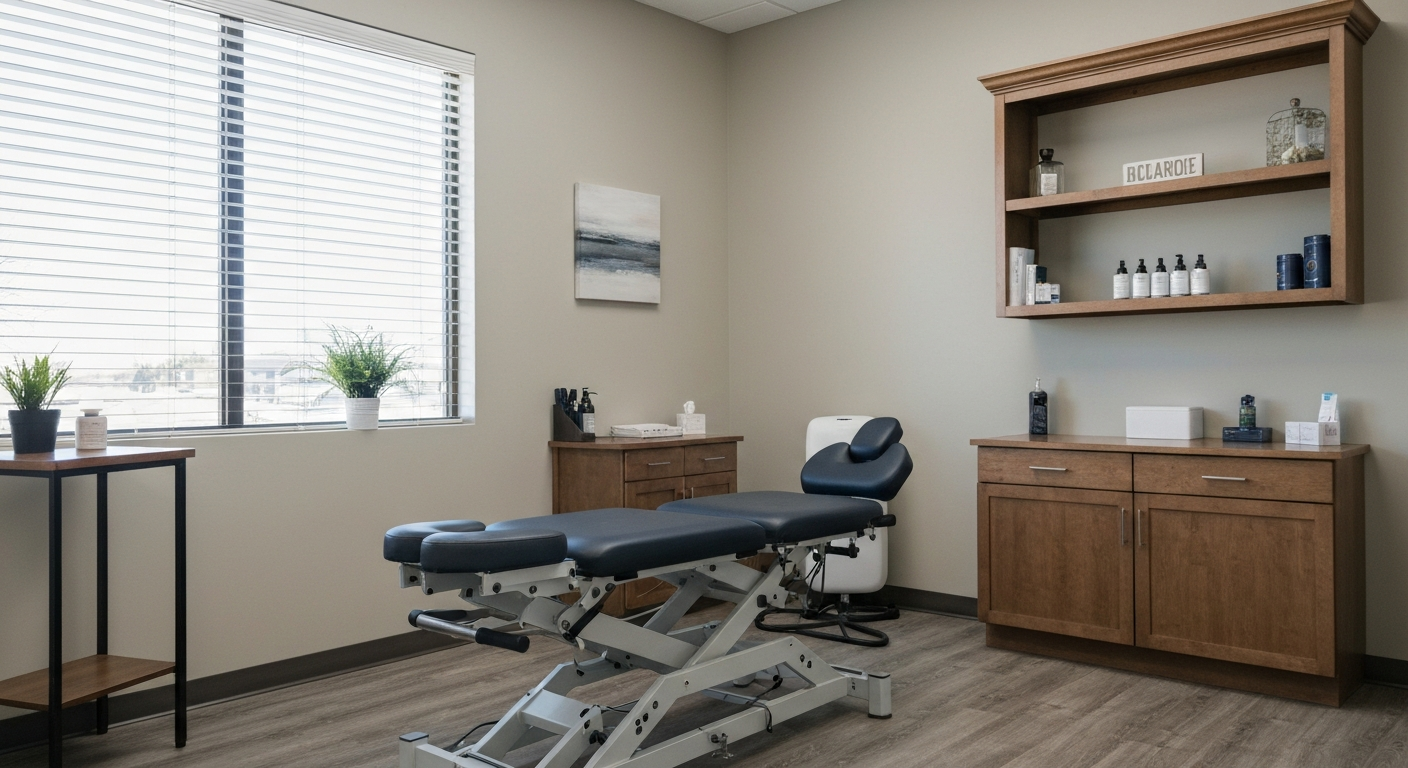
- Chiropractic tables. A quality adjusting table runs $2,000–$10,000+. If you want a drop table, flexion-distraction table, or hi-lo table, costs add up fast.
- Diagnostic equipment. X-ray systems are the big ticket item — a digital X-ray setup can run $20,000–$40,000 on its own. Some practitioners start without in-house X-ray and refer out, which is a legitimate way to reduce initial capital.
- Therapeutic modalities. Electrical stimulation units, ultrasound therapy, traction devices, cold laser — add several thousand dollars depending on what services you plan to offer.
- Exam room basics. Tables, stools, otoscopes, blood pressure cuffs, scales, goniometers.
- Office equipment. EHR/practice management software, computers, printers, front desk setup.
Buying used equipment from a retiring chiropractor or a reputable medical equipment dealer can cut this number significantly. Just verify that anything you buy is in working order and can be properly calibrated.
Build-Out
Unless you’re lucky enough to find a space that was previously a chiropractic or medical office, you’re probably doing some level of build-out.
$20,000–$75,000 covers most scenarios for a small to mid-size practice. Variables include:
- How many treatment rooms you need (most practices start with 2–4)
- Whether you’re adding X-ray facilities, which require lead-lined walls and a separate electrical setup
- Plumbing modifications if you’re adding a therapy pool or hydrotherapy
- ADA compliance updates to an older space
- Reception area, private consultation room, and restroom configurations
Landlords in medical office buildings sometimes offer tenant improvement allowances that offset build-out costs — negotiate this hard when you’re signing a lease. A $15,000–$25,000 TI allowance on a 3-year lease isn’t unusual in a decent market.
Get at least three contractor bids. Medical build-outs attract contractors who know they can charge premium rates. Competitive bidding helps.
Insurance
You need several types of coverage before you see your first patient.
Malpractice insurance (professional liability). This is non-negotiable. Chiropractic malpractice premiums in Georgia typically run $3,000–$8,000 per year for a solo practitioner, depending on your coverage limits, claims history, and the carrier. Higher-risk techniques or procedures push that number up. Shop multiple carriers — NCMIC, The Doctors Company, and ProAssurance are common options in the chiropractic space.
General liability. Covers slip-and-falls and property damage claims at your office. Usually $500–$1,500/year for a small practice.
Business owner’s policy (BOP). Many practices bundle general liability with commercial property coverage into a BOP, which is typically cheaper than buying them separately.
Workers’ compensation. Georgia requires workers’ comp once you have three or more employees. If you’re solo with no staff, you’re not legally required to carry it — but some landlords require it as a lease condition anyway.
The $3,000–$8,000 figure in the estimates above reflects malpractice alone. Budget another $1,000–$2,000 for general liability, BOP, and workers’ comp if applicable.
Credentialing
If you plan to accept insurance — Medicare, Medicaid, or commercial payers — credentialing is a separate process that runs parallel to all of the above. Medicare credentialing through CMS can take 60–90 days. Commercial payer credentialing varies. Start this process early, ideally before you open, because you won’t get reimbursed for patients seen before your effective date.
Some new practices open cash-pay only to avoid the credentialing delay, then add insurance payers in month two or three. That’s a valid approach if your target market supports it.
Total Startup Cost Estimate
Add it all up and you’re looking at $60,000–$180,000 to open a chiropractic practice in Georgia. Here’s roughly where that lands:
| Item | Low | High |
|---|---|---|
| LLC formation + Annual Registration | $160 | $160 |
| Equipment | $20,000 | $80,000 |
| Build-out | $20,000 | $75,000 |
| Insurance (year one) | $4,000 | $10,000 |
| EHR/software (year one) | $1,500 | $5,000 |
| Marketing/signage | $2,000 | $8,000 |
| Misc. (supplies, deposits, working capital) | $12,000 | $25,000 |
| Total | ~$60,000 | ~$180,000 |
The wide range is real. A practitioner who buys used equipment, finds a build-out-ready space, and starts cash-pay-only can land near the low end. Someone building out a new space with in-house X-ray and full credentialing from day one will be closer to the high end — or above it.
Most solo practitioners finance some portion of this through an SBA 7(a) loan or a practice acquisition loan from a healthcare-focused lender. Your state chiropractic association — the Georgia Chiropractic Association — is a useful resource for lender referrals and practice startup guidance specific to this state.
Next Steps
Get your chiropractic license first. Everything else — the LLC, the lease, the equipment — waits on that. While your application is under review at the SOS Professional Licensing portal, use the time productively: research locations, interview EHR vendors, and talk to a CPA about the right entity structure for your situation.
When you apply for your Occupation Tax Certificate locally, ask specifically about the Professional Practitioner flat fee under O.C.G.A. § 48-13-9(c). It’s a small but real annual savings, and it simplifies your reporting.
The licensing path is clear. The costs are knowable. Start with the board application at sos.ga.gov and work forward from there.