How to Start a Business in Hinesville, Georgia
How to Start a Business in Hinesville, Georgia
Hinesville is a military town, and that’s not a caveat — that’s the entire pitch.
Fort Stewart sits right next door. Home of the 3rd Infantry Division, it’s the largest Army installation east of the Mississippi. That one fact shapes everything about doing business here: the customer base, the spending patterns, the seasonal rhythms, and the specific gaps in the local market that a smart business owner can fill.
If you’re thinking about starting a business in Hinesville, here’s exactly how to do it — and why the opportunity is more real than most people realize.
Why Hinesville for Your Business
Hinesville has roughly 37,300 residents as of 2026, making it the county seat of Liberty County and one of Georgia’s fastest-growing cities. That growth isn’t accidental. It’s driven almost entirely by what’s happening a few miles down the road at Fort Stewart.
The post supports tens of thousands of soldiers, family members, civilian employees, and contractors — all of whom live, shop, eat, and spend money in and around Hinesville. The median age here is 28.9. That’s extraordinarily young, and it matters enormously for business. You’re not selling to retirees on fixed incomes. You’re selling to young families with dual incomes, steady military paychecks, housing allowances (BAH), and in many cases deployment pay that accumulates while they’re overseas and gets spent when they come home.
Median household income runs $60,028. The demographic skew — 101.7 males per 100 females — is typical of military communities and worth factoring into your product or service mix.
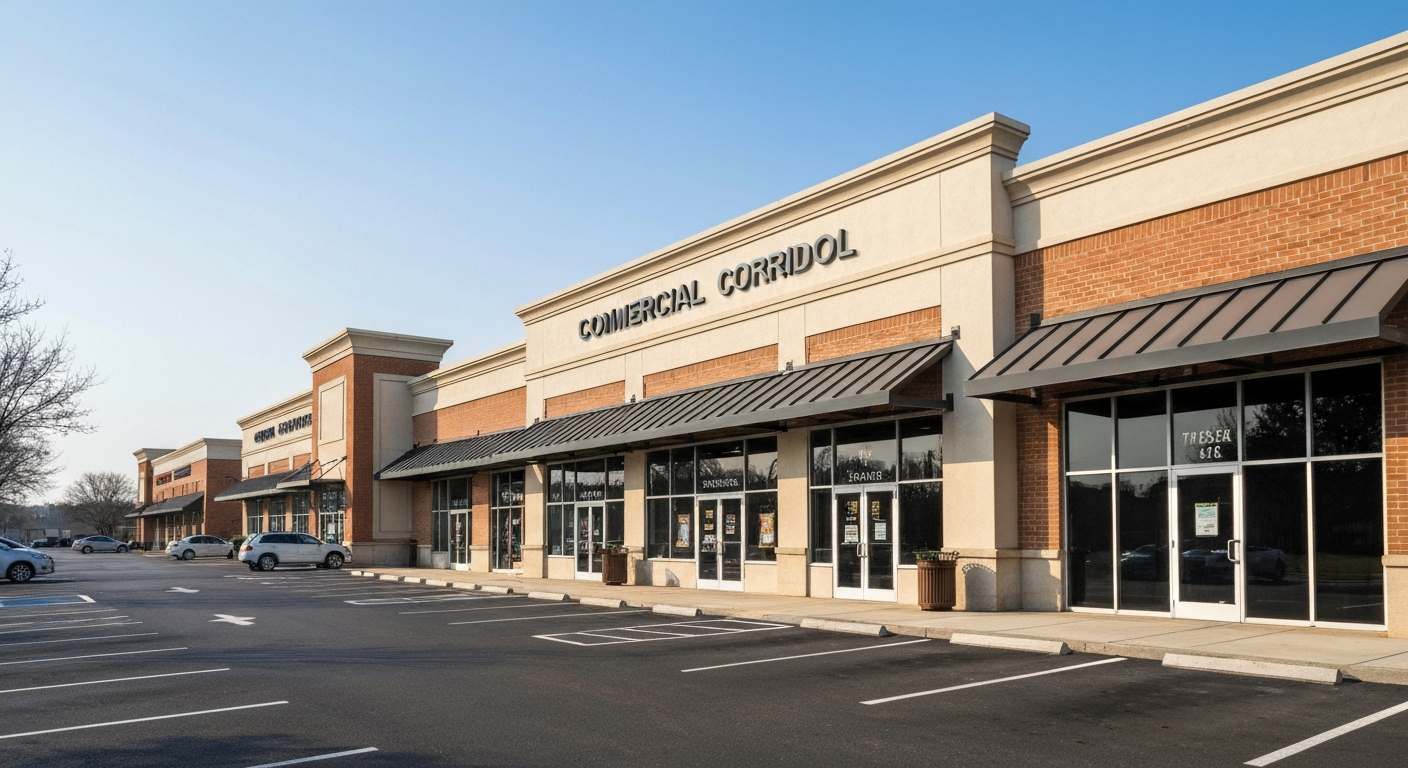
Veterans Memorial Parkway is the main commercial artery. Drive it and you’ll get a quick read on what’s already there and, more importantly, what’s missing. The corridor serves both the military community and the broader civilian population, and there’s still room for the right businesses.
Hinesville isn’t isolated, either. It sits about 40 miles southwest of Savannah and roughly 20 miles from the Georgia coast. That proximity matters for tourism-adjacent businesses and for any supply chain logistics you’re thinking through.
The Liberty County Chamber of Commerce offers startup guides and small business resources if you want local contacts and introductions. The city’s own stated vision — a “coastal southern living community of choice in Georgia” — signals a local government that’s at least trying to attract and retain businesses.
The core opportunity, though, is simpler than any vision statement: 30,000-plus people with stable income live near a commercial market that has not fully caught up to their needs. That gap is where your business goes.
Choose Your Business Structure
Before you can get a business license, you need a legal entity. Three realistic options for most people starting out:
LLC is the most popular choice for good reason. It separates your personal assets from business liabilities without requiring the full formality of a corporation. File online at ecorp.sos.ga.gov for $100. Standard processing takes 5–12 business days; pay an extra $100 for 2-day expedited or $250 for same-day if timing matters. After that, you owe $60 per year in annual registration fees (a $50 fee plus a mandatory $10 service fee, effective September 6, 2025), due between January 1 and April 1. Miss that window and there’s a $25 late penalty. Let it go 60 days past the deadline and the state can administratively dissolve your LLC.
Sole proprietorship is the simplest structure. No state filing required, but if you’re operating under a name other than your own legal name, you’ll need to register that DBA (doing business as) with the Liberty County Superior Court Clerk. Cheap and fast, but you get no liability protection. Your personal assets are on the line.
Corporation costs the same as an LLC to form — $100 online through the Secretary of State’s eCorp portal. Most solo founders and small teams don’t need a corporation at the start, but if you’re raising outside capital or have specific tax reasons for the structure, it’s there.
When in doubt, most first-time business owners in Georgia are well-served by the LLC. Simple, protective, credible.
Register with the State
Forming your entity is step one. Step two is getting right with Georgia’s tax system.
Head to the Georgia Tax Center at gtc.dor.ga.gov. This is where you register for sales tax collection, employer withholding (if you’re hiring), and corporate income tax if applicable. Georgia’s state income tax is a flat 5.19% for 2025, dropping to 5.09% in 2026 under HB 111. Corporate income tax sits at 5.75%.
You also need a federal Employer Identification Number (EIN) from the IRS — free, takes about five minutes at irs.gov/ein. Get this even if you have no employees. Banks require it to open a business account.
One thing that deserves honest attention: Liberty County’s sales tax is 8% — 4% state base plus 4% county. That’s among the higher rates in Georgia. For most service businesses, it’s irrelevant. For retail — especially big-ticket items like electronics, appliances, or auto parts — it’s a real factor. Military families are comparison shoppers. They’ll drive to an adjacent county or order online if the price difference is meaningful on a major purchase. Price accordingly and lean into service and convenience, not just product, if you’re in retail.
Get Your Hinesville Business License
Every business operating in Hinesville must have a license before opening. Not after you’ve been running for a few weeks. Before. The city can fine or shut down unlicensed businesses, and that’s not a theoretical risk — they enforce it.
Where to go: City Hall at 115 East M.L. King, Jr. Drive, Hinesville, GA 31313. The Business License Office operates within the City Clerk’s Office.
The one-stop-shop approach: Hinesville uses a genuinely efficient system here. When you visit the Business License Office, they coordinate with all the city departments involved in your specific license type. You meet with everyone in one visit rather than bouncing between offices over multiple days. For a first-time owner trying to figure out who approves what, this is a real advantage.
Before you go, download your forms from cityofhinesville.org. One critical detail that will save you a wasted trip: the forms require legal-size paper (8.5” × 14”) to print correctly. Standard letter-size will cut off the form. Print at home, a UPS Store, or a library — just make sure it’s legal size.
If you’re operating from home, look up City Code Section 607 before you do anything else. Home occupation businesses have specific restrictions and require a separate acknowledgement form. Not all business types qualify.
Two mandatory affidavits — and this applies to every Georgia business license application, not just Hinesville:
- SAVE Affidavit: Under O.C.G.A. § 50-36-1, you must verify lawful presence in the United States. This requires notarization and a Secure and Verifiable Document (driver’s license or passport).
- E-Verify Affidavit: Under O.C.G.A. § 36-60-6, if your business has 11 or more employees, you must register for E-Verify and provide your user number. Fewer than 11 employees? You file an exemption affidavit instead. Either way, the affidavit is required.
Get both notarized before you show up. Most UPS Stores and banks offer notary services.
License renewal: Hinesville business licenses expire December 31 each year. You become delinquent after 90 days — meaning you have until roughly the end of March before penalties kick in. That’s the most generous grace period of any city in this region. But don’t read that as an invitation to be late. Build the renewal into your calendar in January and be done with it.
Selling alcohol? Georgia centralized alcohol licensing through the Georgia Tax Center via the Alcohol Licensing Portal (ALP) under O.C.G.A. 3-2-7.1. Start that process early — alcohol licenses take time, and you can’t open a bar or bottle shop until it’s approved.
Zoning and Inspections
Here’s something that trips up a lot of people in Hinesville: zoning is not handled by the city.
In most Georgia cities, zoning sits inside city government. In Hinesville, it’s handled by the Liberty Consolidated Planning Commission (LCPC) — a separate agency. Before you sign a lease or make any commitments about a physical location, contact them.
LCPC: Historic Courthouse, 100 Main Street, Suite 7520, Hinesville, GA 31313. Phone: 912-408-2030.
Ask them to verify zoning for your specific address and your specific business type. What’s approved for one type of commercial use isn’t automatically approved for another. A hair salon and a food truck commissary have different zoning requirements. Find out before you commit.
If you’re looking at anything in or near downtown Hinesville, pay particular attention to the Downtown Redevelopment Overlay District. It’s divided into five sub-areas, and the Historic Urban Core carries the strictest design review requirements. Exterior changes, signage, and new construction in that zone get more scrutiny than they would elsewhere in the city. That’s not necessarily a dealbreaker, but it adds steps and time to your buildout.
The LCPC is also your contact for questions about permitted uses, variance requests, and anything involving land use. Don’t assume the Business License Office will flag a zoning problem for you — get zoning clearance independently, before anything else.
Open for Business — The Military Market
Once the licenses are in hand, you’re operating in one of the most distinctive local markets in Georgia. Here’s what actually matters for building a business here.
Understand the deployment cycle. Fort Stewart units deploy on roughly 9–12 month rotations. When a large unit deploys, thousands of spouses and families are left managing households solo. That creates demand for specific services: lawn care, home repair, childcare, meal prep, anything that makes running a household easier with one less adult. When units return, spending spikes — restaurants fill up, retail moves, automotive services get busy. If you’re paying attention to deployment schedules (which are publicly acknowledged at the unit level), you can staff and inventory accordingly.
PCS season is the biggest event in the Hinesville business calendar. PCS — Permanent Change of Station — is when the Army moves soldiers to new duty stations. The bulk of those moves happen May through August. During that window, thousands of families arrive in the area needing housing, furniture, vehicles, childcare, schools, and every service that goes with starting over in a new place. And thousands more are leaving, which means moving trucks, storage units, and cars being sold or shipped. If your business touches any of those categories, this is your annual peak. Plan for it.
Most soldiers live off-base. Fort Stewart has on-post housing, but the majority of the military community lives in the surrounding area. That means property management and maintenance businesses face near-constant demand. Families rotate in and out every 2–3 years. Landlords who serve military tenants well build reputations that follow them through the community — and landlords who don’t build reputations just as fast.
Healthcare and TRICARE. Military families receive healthcare through TRICARE, the military’s insurance system. Becoming a TRICARE-authorized provider — whether you’re a dentist, physical therapist, counselor, or other healthcare practitioner — opens your practice to an enormous local customer base that already has coverage and is actively looking for providers. The process to become a TRICARE provider takes some time to set up, but it’s worth investigating early if healthcare is your field.
Workers’ compensation is required once you hit three employees in Georgia. If you’re scaling up to staff seasonal demand during PCS season or post-deployment periods, make sure you’re covered before you add that third person.
Finally — and this might be the most important thing to understand about Hinesville specifically — word-of-mouth on base is exceptionally fast. Military units are tight communities. Soldiers and spouses share recommendations constantly, in unit group chats, at FRG (Family Readiness Group) meetings, through unofficial networks that civilian business owners rarely see but that drive enormous amounts of business. One genuinely good experience at your shop or service can ripple through an entire battalion. One bad one travels just as far. Quality and reliability aren’t just good business here. They’re how you grow.
Your First Move
The sequence is straightforward: choose your structure and file with the Secretary of State at ecorp.sos.ga.gov, get your EIN at irs.gov/ein, register with the Georgia Tax Center at gtc.dor.ga.gov, then head to City Hall at 115 East M.L. King, Jr. Drive with your notarized SAVE and E-Verify affidavits and legal-size printed forms from cityofhinesville.org. Check zoning with the LCPC at 912-408-2030 before you commit to any location.
The administrative side is genuinely manageable. Hinesville’s one-stop-shop licensing process is more efficient than most cities this size. The 90-day grace period on renewals is real, even if you shouldn’t test it.
What takes more work is understanding the market well enough to serve it well. The military community here is loyal to businesses that earn it — and underserved by businesses that actually understand what military families need. That’s where the opportunity sits.