How to Get a Business License in Columbus, Georgia
Columbus Business License Basics
Columbus-Muscogee County operates as a consolidated government — one jurisdiction for all business licensing. There’s no separate city license and county license. You deal with the Revenue Division, get one Occupation Tax Certificate, and display it at your place of business.
What sets Columbus apart from other Georgia cities is the two-document requirement: before the Revenue Division will issue a business license, you must first obtain a Certificate of Occupancy from the Inspections and Code Division. That requirement applies to every business — including home-based ones. Miss that step and your license application goes nowhere.
Administered by: Revenue Division, Occupation Tax Section Address: 3111 Citizens Way, Ground Floor, Columbus, GA Phone: (706) 225-4100, option 1 Mailing: Revenue Division–Occupation Tax Section, P.O. Box 1340, Columbus, GA 31902
Licenses expire annually and must be renewed. All businesses operating in Columbus must maintain a current, valid license displayed conspicuously at the business premises.
Step 1: Certificate of Occupancy — Required Before Anything Else
A Certificate of Occupancy (CO) is required before a business license can be issued. No exceptions.
This is the most common point of confusion for new Columbus business owners, particularly those who’ve licensed businesses in other Georgia cities. Columbus mandates the CO for every business type — commercial storefronts, offices, industrial facilities, and home-based operations alike.
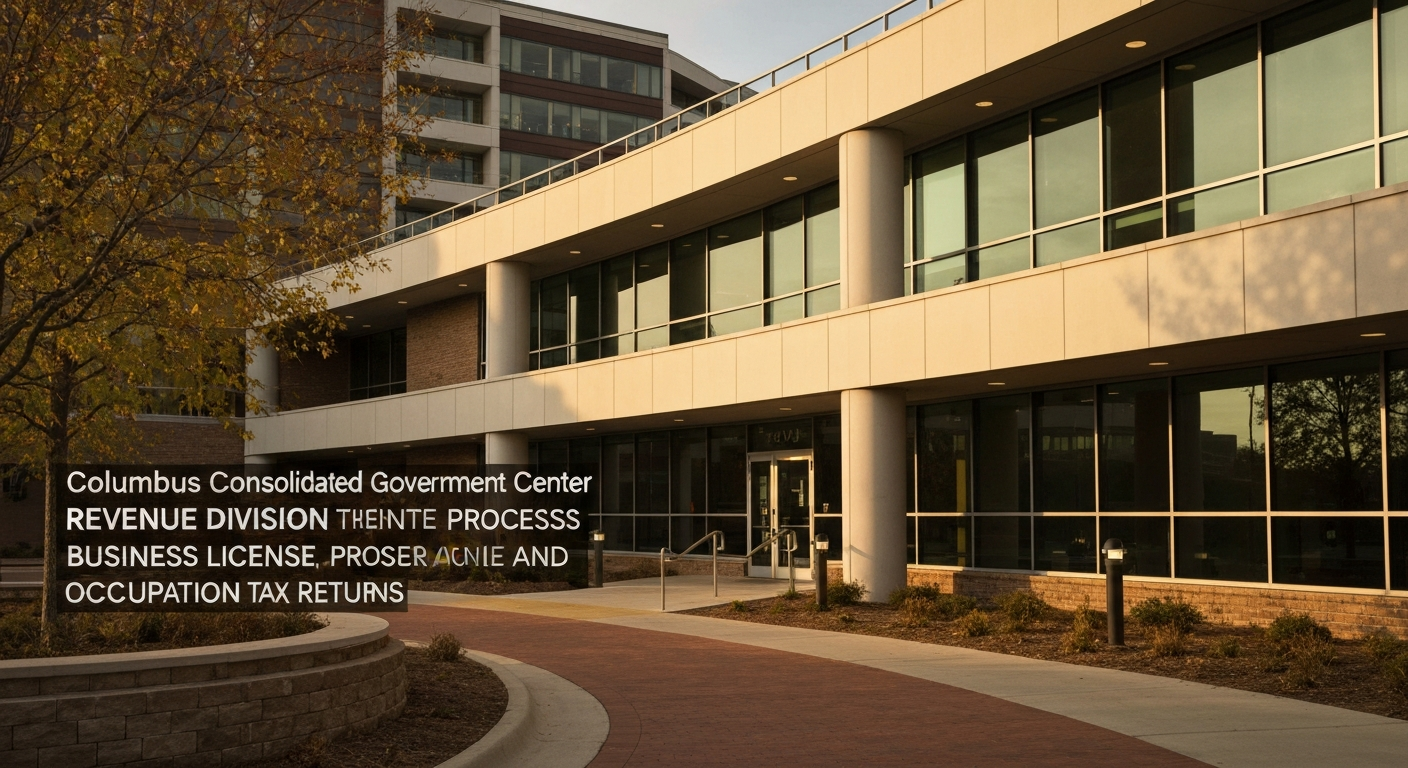
Inspections and Code Division Phone: (706) 225-4126 Location: 2nd Floor, Columbus Consolidated Government Center
What the CO review covers: The Inspections and Code Division confirms that your intended business activity is permitted in the zoning district of your chosen location and that the building meets applicable building and fire code requirements. The review also identifies whether additional approvals from other city departments or state and federal agencies are required.
When you need a new CO:
- Starting a new business (always required)
- Any change in business activity
- Any change in business name
- Any change in business location
Home-based businesses: You still need a Certificate of Occupancy. Contact the Inspections and Code Division to understand the specific CO process for home occupations — the review differs from a commercial location review but the requirement is the same.
Step 2: Complete the Occupation Tax Return
Once you have your Certificate of Occupancy, apply for your business license through the Revenue Division.
Get the Occupation Tax Return form from the Revenue Division. The form is two-sided — complete both sides before submitting. The form must be completed in ink or typed, then signed and dated.
Key fields on the form:
- Business name (legal name and any DBA)
- Business address in Columbus-Muscogee County
- Dominant NAICS code (pre-printed on renewal forms; new businesses select their code)
- FEIN or SSN — required by Georgia law; license will not be renewed without it
- Column A: prior year’s actual gross receipts (for renewals)
- Column B: current year’s estimated gross receipts
Professional practitioner election: State-licensed professionals may elect to pay a flat $400 per licensed practitioner instead of the gross receipts calculation. Check Section 19-44 of the Columbus Code for eligibility. If you’re a high-revenue solo practice (attorney, physician, CPA, etc.), calculate both options before choosing.
Required Documents
Gather all of these before submitting your application. Missing documents create delays.
SAVE Affidavit (notarized, current year) Required under O.C.G.A. § 50-36-1. Verifies the applicant’s lawful presence in the United States. Must be notarized. Must include a Secure and Verifiable Document (driver’s license, passport, etc.). A new affidavit is required each year — prior year affidavits are not accepted.
E-Verify / Private Employer Affidavit (notarized, current year) Required under O.C.G.A. § 36-60-6. Employers with 11 or more employees: must provide E-Verify user number. Employers with fewer than 11: submit an exemption affidavit. Must be notarized. Current year only.
Certificate of Occupancy Issued by the Inspections and Code Division. Must be current and applicable to your actual business location and activity.
Georgia state professional license (if applicable) Required for state-regulated professions: doctors, lawyers, contractors, cosmetologists, engineers, and others. You cannot renew your Columbus business license without submitting copies of your current state license and any applicable federal/Georgia license cards.
Tax Rates and How They’re Calculated
Columbus uses a 10-year moving average of national profitability statistics to determine tax classes and rates. This system is designed to produce stable, predictable rates rather than fluctuating year-to-year with each annual data release.
Rates range from $1.00 to $6.00 per $1,000 of gross receipts. Your position in that range depends on your dominant NAICS code.
Fixed fees:
- Administrative fee: $75
- Certificate of Occupancy fee: $40
- Combined fixed costs before occupation tax: $115
Pawnshops: $150 regulatory fee in lieu of the standard administrative fee.
Gross receipts for tax purposes means total income without deductions for cost of goods sold or operating expenses. The full revenue line, not profit.
What counts as gross receipts:
- Total income from all business activities
- Gains from stocks, bonds, and capital assets
- Commissions
- Fees for services rendered
- Rent, interest, royalty, and dividend income received in conducting the business
Allowed exemptions (report on Form 2):
- Payments to licensed subcontractors
- Inter-organizational transfers within parent-subsidiary groups (e.g., transfers from subsidiary to parent)
- Sales returns and discounts
- Excise taxes collected and remitted (where included in the gross receipts amount)
- Out-of-state sales and services
How new businesses are handled: New businesses estimate gross receipts for the current year on Column B of the form. After the first full year of operation, Column A of the renewal form captures actual gross receipts, and the tax is reconciled against the estimate.
Penalties
Late payment after April 1: 10% penalty plus 1.5% monthly interest on the unpaid balance.
Operating without a valid license: Business closure proceedings and additional penalties under the Columbus Municipal Code.
Both state and Columbus annual requirements apply: Your Columbus occupation tax and your Georgia Secretary of State annual registration ($60/year, due by April 1) are separate obligations. Missing either one creates compliance issues.
Closing a Business
If you’re closing your Columbus business, do not simply stop paying. You must formally close out your license.
Complete and file an Occupation Tax Return with Column A showing your final actual gross receipts. Note the date your business closed on the return. Submit to the Revenue Division.
Tax liability continues until you formally notify the Revenue Division. Businesses that stop operating without filing a final return remain on the rolls and continue accruing obligations.
Georgia-Wide Affidavit Requirements
The SAVE and E-Verify affidavits are required for every business license in Georgia — they’re state law, not a Columbus-specific rule.
SAVE Affidavit (O.C.G.A. § 50-36-1): Verifies lawful US presence. Notarized. Current year. Secure and Verifiable Document required.
E-Verify Affidavit (O.C.G.A. § 36-60-6): 11+ employees: E-Verify enrollment + user number. Under 11 employees: exemption affidavit. Notarized. Current year.
If you’ve operated a business in another state and this is your first Georgia license, plan for notarization. Both documents must be fresh each renewal cycle.
The Professional Practitioner Option
Under O.C.G.A. § 48-13-9(c) and Columbus Code Section 19-44, state-licensed professionals may choose between two payment methods:
- Gross receipts calculation using the 10-year moving average rate for your NAICS class
- Flat $400 per licensed practitioner — regardless of gross receipts
The flat rate saves money when your calculated tax (rate × gross receipts) would exceed $400 per practitioner. For high-revenue solo practices or small professional firms, this threshold is often crossed. For larger firms with many licensed practitioners, run the full calculation for both options.
Eligible professions include but are not limited to: attorneys, physicians, dentists, pharmacists, veterinarians, certified public accountants, architects, and other holders of a state license issued under O.C.G.A. Title 43.
Out-of-State Businesses
Out-of-state businesses with no Georgia location but conducting business in Columbus-Muscogee County are still subject to the occupation tax. Activities that typically trigger the requirement include performing services for Columbus-based clients, soliciting sales in Columbus, and delivering goods into Columbus on a regular basis. Contact the Revenue Division at (706) 225-4100, option 1, to determine whether your activity requires registration.
Contact Summary
Revenue Division — Occupation Tax Section (business license) Phone: (706) 225-4100, option 1 Address: 3111 Citizens Way, Ground Floor, Columbus, GA Mailing: P.O. Box 1340, Columbus, GA 31902
Inspections and Code Division (Certificate of Occupancy) Phone: (706) 225-4126 Location: 2nd Floor, Columbus Consolidated Government Center
Georgia Secretary of State Corporations Division ecorp.sos.ga.gov Phone: (478) 207-2440 LLC formation: $100 online, $110 by mail Annual registration: $60/year (effective September 6, 2025) — due by April 1
Georgia Tax Center gtc.dor.ga.gov — sales tax, withholding, corporate income tax registration Sales tax rate in Columbus: 9% (4% state + 5% Muscogee County)
Columbus Business License Checklist
Complete these in order:
- Form business entity at ecorp.sos.ga.gov (LLC: $100 online)
- Obtain Federal EIN at irs.gov/ein (free)
- Register with Georgia Tax Center at gtc.dor.ga.gov
- Obtain Certificate of Occupancy from Inspections and Code Division — (706) 225-4126
- Complete SAVE Affidavit — notarized, current year
- Complete E-Verify Affidavit — notarized, current year
- Gather state professional license copies (if applicable)
- Complete Occupation Tax Return form — both sides, in ink or typed
- Submit to Revenue Division — (706) 225-4100, option 1
- Pay $40 CO fee + $75 administrative fee + calculated occupation tax ($115 fixed before tax)
- Display Occupation Tax Certificate at business premises
- Renew annually — pay by April 1 to avoid the 10% penalty