How to Start a Business in Brookhaven, Georgia
How to Start a Business in Brookhaven, Georgia
Brookhaven didn’t exist as a city until December 17, 2012. Twelve years later, it’s the largest city in DeKalb County and home to one of the highest-income, most-educated customer bases in the entire Atlanta metro. If you’re starting a business and want Atlanta-quality demand without dealing with Atlanta-sized city bureaucracy, Brookhaven deserves a serious look.
Here’s exactly how to get your business legally open here — including the online-only licensing portal that most guides miss.
Why Brookhaven for Your Business
The numbers are hard to ignore. Brookhaven’s population sits at approximately 60,700 (2026 estimate), making it the second-largest city in DeKalb County. Median household income is $117,663. Per capita income is $85,912. More than 70% of residents hold a bachelor’s degree or higher.
That’s not just a demographic footnote. It means your customer base has money and is accustomed to spending it.
The median age is 34.1 — young professionals, young families, people actively building careers and households. The population is genuinely diverse: 54.6% White, 14.4% Black, 7.5% Asian, with 20.7% foreign-born. That last number is significant if you’re thinking about culturally specific food, services, language-accessible offerings, or anything with an international angle. One in five Brookhaven residents was born outside the United States.
Top employment sectors here are management, business/financial operations, and sales. Children’s Healthcare of Atlanta is among the major employers in the area. The workforce skews heavily professional — about 92% work in professional or administrative fields. If you’re in B2B services, consulting, healthcare-adjacent industries, or anything targeting dual-income households, the built-in market is unusually strong for a city of 60,000.
Location is a genuine advantage. Brookhaven sits inside I-285 — the Perimeter — with direct MARTA rail access at the Brookhaven/Oglethorpe University station. That station connects directly to downtown Atlanta and Hartsfield-Jackson Airport. For employees who don’t drive, for clients coming from Atlanta, for a business that needs transit connectivity, this matters. Next door, Perimeter Center represents over 29 million square feet of office space — one of the largest suburban office markets in the Southeast. The commuter traffic alone creates demand.
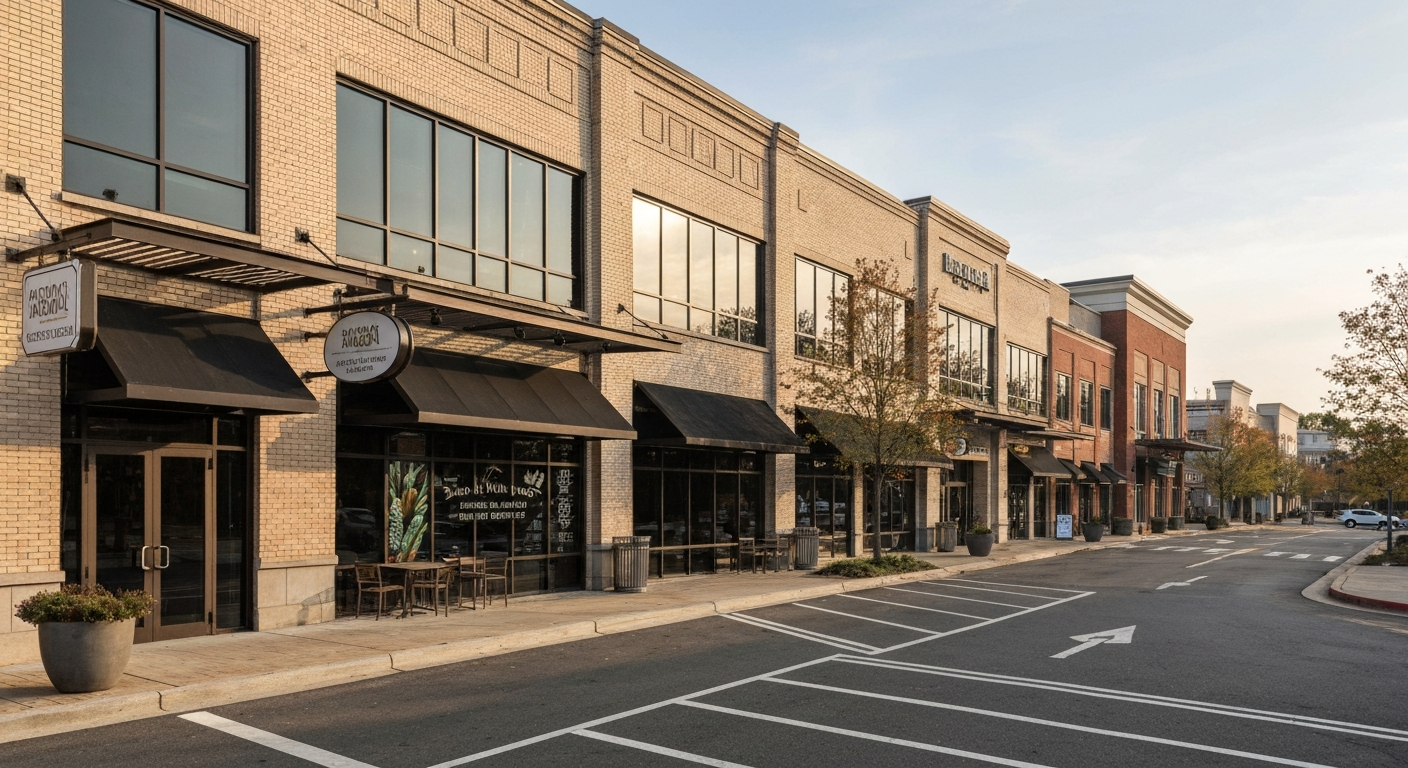
The Dresden District deserves its own mention. This entertainment corridor runs through the heart of Brookhaven and operates under an open-container policy — meaning customers can walk between bars and restaurants with drinks in hand. That’s unusual for a suburban Georgia city and it creates something most small markets don’t have: organic foot traffic and a built-in nightlife and dining culture. If you’re opening a restaurant, bar, coffee shop, or any retail concept that benefits from walk-by traffic, Dresden is a legitimate asset.
City Hall is at 4362 Peachtree Road, Brookhaven, GA 30319, phone (404) 637-0500. The Development Authority contact for business assistance is Aaron Szarowicz at (404) 637-0505 — worth a call before you start if you have questions about incentives or specific location decisions.
And for quality-of-life context: Murphey Candler Park offers 135 acres with a lake, trails, and athletic fields. Brookhaven has parks, walkable corridors, and a suburban feel with urban access. That combination is exactly why it attracts the demographic it does.
Choose Your Business Structure
Before you apply for a city license, you need a legal business entity — or at least a clear decision about how you’re operating. Georgia gives you a few main options.
LLC is the most common choice for small businesses, and for good reason. It protects your personal assets, has minimal ongoing maintenance, and is straightforward to form. File online at ecorp.sos.ga.gov for $100. Annual registration is $60 per year (a $50 base fee plus a mandatory $10 service fee, effective September 6, 2025), due between January 1 and April 1 each year. Missing that deadline costs you a $25 late penalty, and the state can administratively dissolve your LLC about 60 days after the April 1 cutoff.
Sole proprietorship is technically the default if you’re operating without forming any entity — no paperwork required to exist, though you’ll still need all the local licenses. If you want to operate under a name other than your own (a DBA — “doing business as”), you register that with the DeKalb County Superior Court Clerk. Not the state, not the city — the county clerk.
Corporation also files through the Georgia Secretary of State’s eCorp portal at $100 online. Corporate income tax in Georgia runs 5.75%. Most people starting small don’t need a C-corp, but if you’re raising outside investment or have specific tax strategy reasons, it’s available.
Not sure which to choose? LLC for most people. Sole prop if you’re testing a side project before committing. Talk to a CPA or business attorney before choosing a corporation — the tax implications get complicated fast.
Register with the State
Once you have your entity, you need to handle state-level tax registration before you can fully operate.
Georgia Secretary of State handles entity formation at ecorp.sos.ga.gov. That’s where your LLC or corporation lives on record.
EIN (Employer Identification Number) from the IRS is free and takes about 10 minutes at irs.gov/ein. You need this for a business bank account, for paying employees, and for most tax registrations. Even if you have no employees, get an EIN — it keeps your Social Security number off business paperwork.
Georgia Tax Center at gtc.dor.ga.gov is where you register for state sales tax, employer withholding, and corporate income tax. If you’re selling taxable goods or services in Georgia, you need a sales tax permit through GTC before you make your first sale.
Here’s something retail businesses in Brookhaven need to know: DeKalb County’s sales tax rate is 8%. That’s 4% state base, 3% DeKalb County, plus 1% special purpose local option sales tax. That puts DeKalb among the higher sales tax jurisdictions in the Atlanta metro. It doesn’t affect whether you should open here, but it’s a real number to build into your pricing model — especially if you’re competing with businesses in lower-tax counties.
Georgia’s state income tax is a flat 5.19% for 2025, dropping to 5.09% for 2026 under HB 111. No local or city income tax anywhere in Georgia. That’s a significant advantage over states where cities layer their own income taxes on top of state rates.
Get Your Brookhaven Occupation Tax Certificate
This is the local business license. Every business operating in Brookhaven must have a current Occupation Tax Certificate — and there’s one critical thing to know before you start: as of January 2024, all applications are submitted online through the GovOS portal at brookhavenga.munirevs.com. No paper applications. No payments at City Hall. The entire process is online.
If you’ve found older guides that tell you to walk into City Hall with a check, they’re wrong. That process ended in January 2024.
How the tax is calculated:
Brookhaven uses a NAICS-code-based tax structure. The formula is:
(Gross receipts − $20,000 exemption) × your NAICS-code rate
The $20,000 exemption comes off the top before the rate applies. It’s not a huge break, but it’s something. Your rate depends on what industry code your business falls under. NAICS codes are the federal classification system — you can look yours up at census.gov/naics or naics.com.
Professional practitioners have a separate option. If you’re a state-licensed professional — attorney, CPA, physician, architect — you can elect to pay a flat $400 per practitioner instead of the gross-receipts calculation. For solo or small professional practices, that flat rate is often the better deal. This comes from O.C.G.A. § 48-13-9(c).
What you’ll need to complete your application:
- Zoning approval (the city confirms your location is zoned for your business type)
- Certificate of Occupancy from the Permits Department
- SAVE Affidavit — verifying lawful presence in the United States. Requires notarization and a Secure and Verifiable Document (driver’s license or passport). Required under O.C.G.A. § 50-36-1.
- E-Verify documentation — if you have 11 or more employees, you must register with E-Verify and provide your user number. Fewer than 11 employees? You file an exemption affidavit instead. Required under O.C.G.A. § 36-60-6.
Home-based businesses are permitted in Brookhaven but require a Home Occupation Form as part of the application. There are rules on signage, traffic, employees on-site, and what kinds of business activities are allowed in residential zones — confirm the specifics during the zoning approval step.
Renewal deadline: April 30. That’s the latest renewal deadline in the Atlanta-area cities covered in this guide series. If you miss it, you’re looking at a 10% penalty plus 1% interest per month on the unpaid amount. Not catastrophic, but avoidable.
Alcohol licenses renew on a different schedule: October 1 through November 30.
Two more things to know: The Occupation Tax Certificate is not transferable. If you move locations or ownership changes hands, the new situation requires a new application — you can’t transfer the existing certificate. And if you’re purchasing an existing business, the seller’s license doesn’t carry over to you.
Zoning, Inspections, and Special Permits
Getting the license application filed is one thing. Getting approval requires clearing a few practical hurdles first.
Verify zoning before you sign anything. This is genuinely important. Email the Community Development department at the city to confirm your intended location is zoned for your business type. Don’t assume commercial space is zoned for your specific use — a restaurant, a medical office, a retail store, and a personal services business can all have different zoning requirements even in the same strip mall. Getting this wrong after signing a lease is an expensive mistake.
Certificate of Occupancy comes from the Permits Department. For commercial spaces, you generally need a C/O confirming the space is suitable for occupancy in your business category. If you’re doing buildout or renovation, a separate building permit is required before the C/O.
Fire inspection is required for commercial locations. Budget time for this — scheduling can take a few weeks depending on the inspection calendar.
Alcohol licensing has its own process and it’s thorough. Applications require:
- Background check on the applicant
- Background checks on all owners holding 10% or more interest
- Application submitted in duplicate
- Driver’s license copy
- Two original photos of the applicant
Alcohol licensing in Brookhaven is jointly enforced by the Finance Department and Public Safety. This isn’t a rubber stamp — the city takes it seriously. Give yourself extra lead time if alcohol is part of your concept.
Employee permits are required for workers in alcohol-related businesses. Individual employees need permits, not just the business. Factor that into your hiring timeline.
Sign permits require a separate application. If you’re putting up exterior signage — which you almost certainly are — don’t assume it’s covered by your business license or C/O. Submit the sign permit application separately and get approval before installation. Unapproved signs get citations.
Open for Business
You’ve got your entity, your state registrations, your Occupation Tax Certificate, and your C/O. A few more things before you flip the sign.
Workers’ compensation insurance is required in Georgia once you have three or more employees. This is state law, not just a Brookhaven rule. Get this in place before you hire your third person.
Business banking. Open a dedicated business bank account immediately. Mixing personal and business finances is how sole proprietors accidentally lose liability protection and how everyone ends up with a tax nightmare. Bring your EIN, your Articles of Organization (if you have an LLC), and your Occupation Tax Certificate.
Brookhaven Chamber of Commerce is worth connecting with early. The Chamber runs networking events, provides local business visibility, and gives you access to people who’ve already figured out what you’re figuring out now. For a city this size, the Chamber is genuinely active.
Use your location. If you’re near the Brookhaven/Oglethorpe MARTA station, mention it in your marketing. Clients coming from Buckhead, Midtown, or the airport can reach you without driving. For service businesses, that transit connection removes a real friction point. Not every suburban Atlanta business can say that.
Dresden District opportunity. If your concept is food, beverage, entertainment, or any retail that benefits from walk-by traffic, the Dresden District’s open-container policy creates a neighborhood dynamic that’s unusual for a city this size. Foot traffic on a Friday evening in Dresden looks more like a small urban district than a suburban strip. If you’re evaluating locations within Brookhaven, a Dresden District address carries real commercial value.
Watch the rezoning activity. Brookhaven is actively developing — new residential and mixed-use projects are in various stages of approval throughout the city. If you’re signing a long lease, check what’s planned for the surrounding blocks. A construction zone today might be 200 new apartment units in 18 months, which changes foot traffic projections significantly. The Community Development department can tell you what’s in the pipeline near any address you’re considering.
One last thing: Brookhaven is young as a city and has built a reputation for being responsive to business owners. When you have a question, call. The Development Authority contact — Aaron Szarowicz at (404) 637-0505 — is there specifically to help businesses land and grow here. Use that resource.
The Short Version
Brookhaven has the income, the education level, the transit access, and the demographic mix to support almost any well-run business concept. The licensing process is straightforward once you know the GovOS portal is the only way in. The April 30 renewal deadline gives you more runway than most Georgia cities. And the Dresden District gives food and beverage operators something genuinely rare: a built-in reason for people to be outside and spending.
The path is: form your entity → get your EIN → register at Georgia Tax Center → verify zoning → apply for your Occupation Tax Certificate through GovOS → get your C/O and any special permits → open.
Call Aaron Szarowicz at (404) 637-0505 if you’re serious about a specific location or have questions the portal can’t answer. That’s what the number is there for.